
stick n move
Superstar
- Joined
- Oct 14, 2009
- Messages
- 13,919
- Reaction score
- 26,435

 nemasket.theweektoday.com
Do the procedures for buses at railroad crossings include proceeding across the tracks even if "sightlines are significantly limited?" And if the driver started to go through the crossing before the lights came on, shouldn't they have continued through (even if they hadn't "reached the tracks yet")? There's a buffer period, and putting the bus in reverse seems like the wrong thing to do under almost any circumstance.Freelake school bus struck by equipment at MBTA crossing
FREETOWN — On the second day of Southcoast Rail MBTA service, a Freetown-Lakeville school bus was struck by a crossing arm at a railroad track on Braley Road in Freetown. No injuries were reported in the incident, Acting Superintendent of Schools John Higgins told the Freetown-Lakeville School...
That's a tough crossing. it's at the top of a rise in the road and it crosses the tracks at an acute angle. Maybe the gates are timed to go down too soon after the activation of the warning lights. I'm sure they are looking right now at what can be done to reduce the chance of this happening again.Freelake school bus struck by equipment at MBTA crossing
FREETOWN — On the second day of Southcoast Rail MBTA service, a Freetown-Lakeville school bus was struck by a crossing arm at a railroad track on Braley Road in Freetown. No injuries were reported in the incident, Acting Superintendent of Schools John Higgins told the Freetown-Lakeville School...
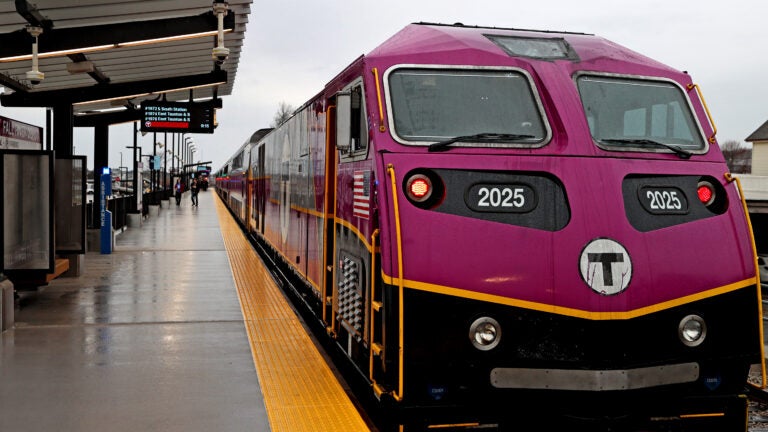
I mean, if I were a kid and I’d thought my schoolbus was about to be smashed by an oncoming train, I’d probably still be a little freaked out the next day. (“See tracks? Think trains” is pretty heavily predicated on the concept that you’ll die if a train hits you.) And these are probably just the normal guidance counselors who would be there anyway. Nothing wrong with school admins giving some consideration to the emotional well-being of their students.I think what gets me the most of this article is this line: Counselors were available at school the next day to check for any physical or emotional impacts of students who were involved, Higgins said.

Yeah, I've personally come to the conclusion that SCR Phase 1 is more useful for occasional trips to the two cities (for leisure, family etc), especially for those who can't or prefer not to drive, than for frequent commutes. Don't get me wrong -- that has value in itself, as I can already imagine myself doing a day trip to New Bedford for reasons unrelated to transit. But it certainly leaves much to be desired.Great to be able to take public transport to New Bedford. But it should only take an hour. No one is commuting that long if the service is unreliable.
Hopefully it's the first step with major improvements coming.
In it's current form, I'm not sure who it's for.
Great to be able to take public transport to New Bedford. But it should only take an hour. No one is commuting that long if the service is unreliable.
Hopefully it's the first step with major improvements coming.
In it's current form, I'm not sure who it's for.
I think my feelings on South Coast Rail remain unchanged from several years ago. In particular:Yeah, I've personally come to the conclusion that SCR Phase 1 is more useful for occasional trips to the two cities (for leisure, family etc), especially for those who can't or prefer not to drive, than for frequent commutes. Don't get me wrong -- that has value in itself, as I can already imagine myself doing a day trip to New Bedford for reasons unrelated to transit. But it certainly leaves much to be desired.
It's like planting trees: the best time to (re)build a rail line was yesterday; the second best time is today.
Now, I do worry about service suspension and then a lack of maintenance. That is a gamble here, I agree. If the stations or rails are left to deteriorate completely, then we're back to square one. (Although can you imagine the optics?)
But, to my knowledge, no commuter rail service in the US or Canada has been indefinitely suspended in the last... 20 years? ... Shore Line East, Wickford Junction, Greenbush... once (mainline) trains start running somewhere, it seems extremely rare that they get eliminated outright.
(I will grant that there have been one-off suspensions ... [but] that's different than shutting down an entire subnetwork.)
So Baker or his successors just shutting down the service due to low ridership seems unlikely to me. Yes, there will be artificially depressed ridership for certain, and it will be up to advocates to continue holding the state's feet to the fire.
[W]e've got the money now, and we've convinced enough people to build a key part of the expansion. Is it going to be "successful"? I dunno. Are we no doubt going to see lots of Globe articles talking about "underwhelming ridership"? Oh probably.
But the stations will be built. And the tracks will be upgraded. And no number of Globe editorials or MassDOT ridership powerpoints or even service suspensions will undo that progress.
 city.ridewithvia.com
On what planet does driving between Boston and the South Coast during rush hour take less time than the train, because it isn't this one. I had the pleasure of driving down there yesterday. It took two and a half freaking hours and I left at 7:30 in the morning. In fantasyland, where everyone can go at least the speed limit with no accidents, construction or cops looking to meet a quota along the way, sure maybe you can make it there in less than 90 minutes. In reality, does that ever happen? Let's have a bit of honestly here when assessing the actual commute for most people, and if you still prefer to drive so be it.
No problem. Try doing that commute yourself and let me know if you actually get to Boston from Fall River in the morning in a hour and 5 minutes. Oh, and the car you're driving can't be using lights and sirens as you travel up the highway.Google Maps estimates the following drive times based on traffic estimates:
South Coast Rail travel times could be competitive with driving time between 7:00-10:00am and 2:00-6:00pm for trips specifically to/from Downtown Boston, but not for trips terminating anywhere else or at any other times of day.
- New Bedford Station to South Station, arriving at 8:30am on a Wednesday: 1:15-2:10.
- Fall River Station to South Station, arriving at 8:30am on a Wednesday: 1:05-2:00.
- South Station to New Bedford Station, departing at 4:00pm on a Wednesday: 1:15-2:10.
- South Station to Fall River Station, departing at 4:00pm on a Wednesday: 1:10-2:00.
Eh, I did this commute for 3 years (2014-2017). The low end of those Google estimates are basically the drive times with no-traffic, under ideal conditions (basically, no weekday morning/evening ever). The high end is closer to the norm under normal circumstances. Add additional time for an accident, HOV lane breakdown, light rain, etc.Google Maps estimates the following drive times based on traffic estimates:
South Coast Rail travel times could be competitive with driving time between 7:00-10:00am and 2:00-6:00pm for trips specifically to/from Downtown Boston, but not for trips terminating anywhere else or at any other times of day.
- New Bedford Station to South Station, arriving at 8:30am on a Wednesday: 1:15-2:10.
- Fall River Station to South Station, arriving at 8:30am on a Wednesday: 1:05-2:00.
- South Station to New Bedford Station, departing at 4:00pm on a Wednesday: 1:15-2:10.
- South Station to Fall River Station, departing at 4:00pm on a Wednesday: 1:10-2:00.
all the more reason the train should be fast and reliable.No problem. Try doing that commute yourself and let me know if you actually get to Boston from Fall River in the morning in a hour and 5 minutes. Oh, and the car you're driving can't be using lights and sirens as you travel up the highway.
I think the question is more what the total transit time is, including getting to and from the termini stations. If you live close to a stop and work close to South Station, great. But I’m sure there are people who park in a garage that’s close to the office, yet work might be a 20 minute T ride or walk from S Station. Even so, it blows my mind how people sit in traffic for so much of their lives. Being able to relax on a train and maybe get work done or read vs trapped in a car and having to focus on driving is a no brainer to me.On what planet does driving between Boston and the South Coast during rush hour take less time than the train, because it isn't this one. I had the pleasure of driving down there yesterday. It took two and a half freaking hours and I left at 7:30 in the morning. In fantasyland, where everyone can go at least the speed limit with no accidents, construction or cops looking to meet a quota along the way, sure maybe you can make it there in less than 90 minutes. In reality, does that ever happen? Let's have a bit of honestly here when assessing the actual commute for most people, and if you still prefer to drive so be it.
I could not agree more. It’s just such a missed opportunity, as Phase 2 would actually cause a mode shift towards transit.Eh, I did this commute for 3 years (2014-2017). The low end of those Google estimates are basically the drive times with no-traffic, under ideal conditions (basically, no weekday morning/evening ever). The high end is closer to the norm under normal circumstances. Add additional time for an accident, HOV lane breakdown, light rain, etc.
I agree that the SCR times are less than ideal and won't realistically attract new daily commuters. They're just too long. But I'd argue that the real world travel times probably compete with or beat real-world drive times for most Boston area commuters. Back Bay and Longwood are probably a quicker drive under most conditions since the transfer options are limited and slow. But Financial District, Government Center, Beacon Hill, North Station and just about anything in Cambridge/Somerville that's not immediately off of I-93 is probably better via the train. Even with a transfer.
I think Phase 1 is going to mostly improve travel comfort for people who are already making the commute. It'll also make visiting Boston easier for a day trip. If I still lived in the area, it would easily be my default mode of commuting now. But it's certainly not going to entice new Boston commuters to FR/NB.
FYI -SRTA has started this "Uber" type service in both cities. Spotted two of their mini-vans staged in the NB parking lot.