Other People's Rail: Amtrak, commuter rail, rapid transit news & views outside New England

It also sounds like they are being very optimistic about the ability to tunnel directly under existing century old tunnels and stations without causing damage, by using the ground freezing techniques. The reason the design went very deep along 125th Street is because shallow conditions for tunneling are really poor. Shallow tunneling sounds like a recipe for years of damage mitigation.
The Effective Transit Alliance suffers from a perfectionism complex in their technical recommendations. Sort of like how TransitMatters' Regional Rail traffic modeling relies on heavily suspect hyper-aggressive performance expectations with threadbare safeguards...but plied on a more grand scale across all of the ETA's rail advocacy. I guarantee they glossed over the engineering challenges of digging under old streets. Which sucks because there's copious opportunities for cost savings while delivering a better product than the MTA's insane elevator-city access strategy for Phase 2...but the more careless aspects of the ETA's work are ripe for having holes poked in it by skeptical institutionalists clinging to their Not Invented Here ways.
 
They're advocating cut-and-cover, not TBMs.
That's not really correct. They still recommend using TBM for the tunnel, but much more shallow. They do recommend cut-and-cover for the stations, which would be possible by running the TBM closer to the surface. That would be a heck of a lot cheaper than the current plan of mining deep stations.
 
That's not really correct. They still recommend using TBM for the tunnel, but much more shallow. They do recommend cut-and-cover for the stations, which would be possible by running the TBM closer to the surface. That would be a heck of a lot cheaper than the current plan of mining deep stations.
It "might" be a lot cheaper than mining deep stations -- depending on the success of underpinning century old infrastructure right over the proposed new stations.

Or it might lead to the closure of multiple other lines for several years of repairs. Big roll of the dice.
 
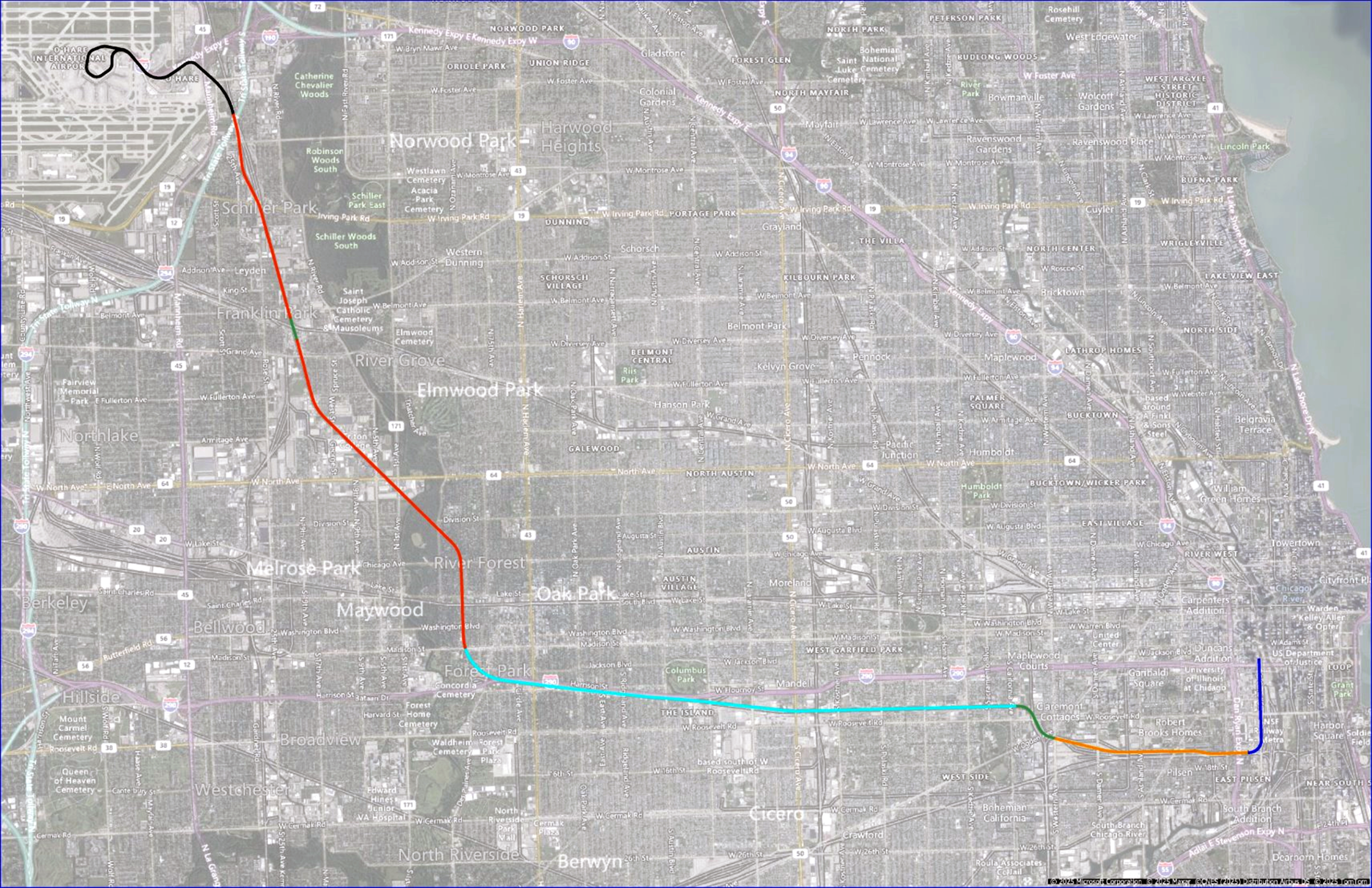
Some crazy nimbyism going on outside chicago where a suburb on the way to ohare is trying to block a new train line between ohare and downtown which is going to just barely pass through their town and theyre doing everything possible so it essentially wouldnt affect the residents at all but of course theyre still furious. Insanity.

 
Some crazy nimbyism going on outside chicago where a suburb on the way to ohare is trying to block a new train line between ohare and downtown which is going to just barely pass through their town and theyre doing everything possible so it essentially wouldnt affect the residents at all but of course theyre still furious. Insanity.

CAVEAT: The outfit that's pitching this smells a whole lot pie-in-the-sky and just a little bit scammy.
 
CAVEAT: The outfit that's pitching this smells a whole lot pie-in-the-sky and just a little bit scammy.
I don't doubt they're being pie-in-the-sky, but what part of this looks scammy? I don't know anything about the people involved.
 
I don't doubt they're being pie-in-the-sky, but what part of this looks scammy? I don't know anything about the people involved.
They're hyping, hyping, hyping that they'll do 15-minute travel times over 20 miles, which requires 80 MPH sustained speeds through four different owners of heavily congested freight railroads, scores of grade crossings, and multiple junctions and sharp-turning wye legs. It's not possible by laws of physics, nevermind if they actually spent the ton of money and herded the cats of the various rail line owners to get each segment up to top passenger operating condition. But that's their core business proposal. It's a little more disingenuous than simply being "pie-in-the-sky".
 
They're hyping, hyping, hyping that they'll do 15-minute travel times over 20 miles, which requires 80 MPH sustained speeds through four different owners of heavily congested freight railroads, scores of grade crossings, and multiple junctions and sharp-turning wye legs. It's not possible by laws of physics, nevermind if they actually spent the ton of money and herded the cats of the various rail line owners to get each segment up to top passenger operating condition. But that's their core business proposal. It's a little more disingenuous than simply being "pie-in-the-sky".
I don't think their plan is as outrageous as you're making it out to be. This presentation has the most details I've seen so far, and they seem to address a lot of your criticisms.

They say they'll have a dedicated line the whole way from O'Hare to their new downtown station. They're using other companies' right of ways, but they'll have their own dedicated track they control. (How exactly they do that changes segment to segment). They're building flyovers at junctions so they really don't have to interact with anyone else. They'll do their own dispatching on essentially a closed system. No interaction with freight whatsoever. And I don't see scores of grade crossings. Long continuous sections are fully grade separated, and they'll remove some of the remaining grade crossings. There's one long section where trains will run 110mph.

15-minute travel times sounds low, but not so out of whack that it looks like a scam.

(I seriously doubt their business model works. But that's a whole other matter.)

 
Governor Hochul today announced that the Metropolitan Transportation Authority (MTA) is advancing the fourth and final construction contract for Phase 2 of the Second Avenue Subway, marking a major milestone toward completing the extension of Q service to 125 St in East Harlem. Following this Request for Qualifications (RFQ), the MTA plans to issue a Request for Proposals to qualified contractors by the end of the year and anticipates selecting a contractor in mid-2027. Contract Four is the largest contract of the Second Avenue Subway Phase 2 project and includes the construction of station infrastructure, tracks, and signals for the subway expansion. Work on Contract Four will begin in 2027.

“New Yorkers have been waiting for the Second Avenue Subway for nearly a century and now, with major work underway, we are moving full speed ahead with the final contract to fully deliver this transformative new transit connection to East Harlem,” Governor Hochul said. “We fought hard to keep this project moving forward earlier this year and finally break ground on new tunnels this summer. Once this contract is completed, three beautiful and accessible new subway stations will welcome East Harlem to the subway line they have long been promised.”

With the first three contracts progressing concurrently, the project budgeted at $6.968 billion is expected to be fully completed by the fall of 2032. This project is made possible by congestion relief revenue and $3.4 billion in federal funding. Upon completion of Phase 2, Q service will run north from 96 St to 125 St and Lexington Ave, an extension of approximately 1.5 miles with three new stations at 106 St, 116 St and 125 St.
 
SEPTA put out their big plan to massively improve service on Philly's Regional Rail. Today it essentially still runs like a 9-5 commuter railroad, but the plan is start running 15 minute headways all day on all lines in the city and inner suburbs. It looks great.


Philly has got to have the best regional rail network in the country, and currently it's just squandered. Lot's of lines, separated from freight, fully electrified, fast EMUs, through-running with multiple downtown stops.... Absolutely incredible network, but then they run an absolutely dismal service. Hopefully they can stick to this new plan and fix that.
 
SEPTA put out their big plan to massively improve service on Philly's Regional Rail. Today it essentially still runs like a 9-5 commuter railroad, but the plan is start running 15 minute headways all day on all lines in the city and inner suburbs. It looks great.


Philly has got to have the best regional rail network in the country, and currently it's just squandered. Lot's of lines, separated from freight, fully electrified, fast EMUs, through-running with multiple downtown stops.... Absolutely incredible network, but then they run an absolutely dismal service. Hopefully they can stick to this new plan and fix that.

Golly is philly lucky that political leaders in the 70s and 80s had their heads screwed on right to build the downtown through-running tunnel. Boston would look like an entirely different city with NSRL and full electrification. We just want hourly diesel service on every line on a weekday to a stub-end on the edge of downtown and we can't even get that.
 
political leaders in the 70s and 80s had their heads screwed on right
I mean I think Reagan saw what happened in Philly with the Centre City Commuter Connection and decided that there couldn't be a second city in the Northeast with such an transit infrastructure advantage.
 
SEPTA put out their big plan to massively improve service on Philly's Regional Rail. Today it essentially still runs like a 9-5 commuter railroad, but the plan is start running 15 minute headways all day on all lines in the city and inner suburbs. It looks great.


Philly has got to have the best regional rail network in the country, and currently it's just squandered. Lot's of lines, separated from freight, fully electrified, fast EMUs, through-running with multiple downtown stops.... Absolutely incredible network, but then they run an absolutely dismal service. Hopefully they can stick to this new plan and fix that.
SEPTA's got a lot of big infrastructure hurdles to clear before that can be possible. For one, the power system on the whole of the ex-Reading side of the system is infamously tapped out, which is the biggest limiter for increasing service on their whole system. They don't even run that good a rush-hour slate because it risks shorting out the lone 1930's-era substation at Wayne Jct. that props up that whole half of the network They're leaning harder on their less- power-hungry push-pull sets with a cheapo purchase of some used beater single-level coaches retired from Montreal to try to stretch things, since the power-hungrier EMU's end up causing the draw brittleness once they reach a certain set length. Despite the travel-time penalties they have to put up with because of push-pull. They'd have to add multiple new substations and re- phase-break the whole of the system to be able to run :15 service anywhere. It's probably a billion-dollar-plus project (and if they're in the mood to spend that much, they might as well convert from 25 Hz/12.5 kV to 60 Hz/25 kV so at least the substations don't have to be completely custom-ordered at huge blowouts). It's also an incredibly dense stop-spaced system, but it's also almost entirely low-platformed as they to-date have outright refused to move towards any more ADA compliance, repeatedly saying "never" for completion of it as a long-term goal. So the amount of padding in their schedules is unacceptably large for the low-platform dwell delay, and that's likely to interfere bigly with trying to run :15 headways because the schedules won't be precise enough to avoid cascading delays from variable low-platform dwells. That's another problem that'll cost billions just to beat back enough to make a difference. To go along with the system's general state-of-repair being pretty poor and the vehicle-side state-of-repair being abysmal (see: recent crises with the 52-year Silverliner IV fleet being forcibly grounded due to repeated fires).

I guess it's a conversation-starter, and that's all well and good if it lights a fire under people to keep pushing for it. But SEPTA's got to stop being the perennial worst-run transit agency in the U.S., start getting some serious amounts of state funding lined up, and start loading up on real world-practice expertise instead of a revolving door of political hacks if they want a prayer of readying themselves for this. They're actually in many ways much further off than the diesel MBTA network is from true RER/UR readiness despite their preexisting electrification.

I mean I think Reagan saw what happened in Philly with the Centre City Commuter Connection and decided that there couldn't be a second city in the Northeast with such an transit infrastructure advantage.
No. The feds did not take kindly to floating 80% of the cost of the Center City Connection only to see SEPTA turn around immediately after accepting the money and slash-and-burn their systemwide service levels (including the mass-abandonment of all the diesel lines and the electric lines' further-flung suburban stations), creating a ridership cratering that took 40 full years to reverse. The feds invested in it with the hope that they'd be making efforts to modernize the rest of their system, not burn it all to the ground. When Reagan took office SEPTA was Exhibit A of the supposed unreliability of trying to prop up commuter railroads because they felt like they got punked, so the whole country had to suffer from years of federal disinvestment as a result.

It's why the NSRL debates are going nowhere without firm prerequisite commitments to upgrade the whole system to RER service standards beforehand. Because of course the tunnel is not going to be worth the money if it sits only half-used by current barely-useful Commuter Rail frequencies. There has to be real momentum built and achieved at running the target frequencies before you get the run-thru tunnel if they want to beat the "SEPTA curse". When Seth Moulton was bloviating in his fly-by-night press junket 2 years ago about that never-released Harvard Study reassessment of NSRL, he took the backwards "build then tunnel, THEN get the frequencies" stance (that ran contrary to what the RER advocacy groundswell by TransitMatters et al. were saying), got frequently asked by interviewers "...but what about when SEPTA didn't following through on that?", and then sat there with a dumb look on his face because he had no answer. It still stings and still carries that much disrepute 45 years later what SEPTA did to itself, in spite of getting their tunnel build. We have to do better by actually delivering on some substantial measure of the service levels before the feds are going to trust another prospective RER system with megaproject funding. Which is why it's probably not such a bad thing that we won't have Moulton to kick around any longer. He might've been sincere in wanting NSRL (or might not...he wasn't exactly year-to-year consistent in his advocacy), but he had absolutely no clue how to pitch it to the fence-sitters both in the public and in the government who had well-founded reasons (e.g. the "SEPTA curse") for their skepticism.

 
SEPTA's got a lot of big infrastructure hurdles to clear before that can be possible. For one, the power system on the whole of the ex-Reading side of the system is infamously tapped out, which is the biggest limiter for increasing service on their whole system. They don't even run that good a rush-hour slate because it risks shorting out the lone 1930's-era substation at Wayne Jct. that props up that whole half of the network They're leaning harder on their less- power-hungry push-pull sets with a cheapo purchase of some used beater single-level coaches retired from Montreal to try to stretch things, since the power-hungrier EMU's end up causing the draw brittleness once they reach a certain set length. Despite the travel-time penalties they have to put up with because of push-pull. They'd have to add multiple new substations and re- phase-break the whole of the system to be able to run :15 service anywhere. It's probably a billion-dollar-plus project (and if they're in the mood to spend that much, they might as well convert from 25 Hz/12.5 kV to 60 Hz/25 kV so at least the substations don't have to be completely custom-ordered at huge blowouts). It's also an incredibly dense stop-spaced system, but it's also almost entirely low-platformed as they to-date have outright refused to move towards any more ADA compliance, repeatedly saying "never" for completion of it as a long-term goal. So the amount of padding in their schedules is unacceptably large for the low-platform dwell delay, and that's likely to interfere bigly with trying to run :15 headways because the schedules won't be precise enough to avoid cascading delays from variable low-platform dwells. That's another problem that'll cost billions just to beat back enough to make a difference. To go along with the system's general state-of-repair being pretty poor and the vehicle-side state-of-repair being abysmal (see: recent crises with the 52-year Silverliner IV fleet being forcibly grounded due to repeated fires).

I guess it's a conversation-starter, and that's all well and good if it lights a fire under people to keep pushing for it. But SEPTA's got to stop being the perennial worst-run transit agency in the U.S., start getting some serious amounts of state funding lined up, and start loading up on real world-practice expertise instead of a revolving door of political hacks if they want a prayer of readying themselves for this. They're actually in many ways much further off than the diesel MBTA network is from true RER/UR readiness despite their preexisting electrification.


No. The feds did not take kindly to floating 80% of the cost of the Center City Connection only to see SEPTA turn around immediately after accepting the money and slash-and-burn their systemwide service levels (including the mass-abandonment of all the diesel lines and the electric lines' further-flung suburban stations), creating a ridership cratering that took 40 full years to reverse. The feds invested in it with the hope that they'd be making efforts to modernize the rest of their system, not burn it all to the ground. When Reagan took office SEPTA was Exhibit A of the supposed unreliability of trying to prop up commuter railroads because they felt like they got punked, so the whole country had to suffer from years of federal disinvestment as a result.

It's why the NSRL debates are going nowhere without firm prerequisite commitments to upgrade the whole system to RER service standards beforehand. Because of course the tunnel is not going to be worth the money if it sits only half-used by current barely-useful Commuter Rail frequencies. There has to be real momentum built and achieved at running the target frequencies before you get the run-thru tunnel if they want to beat the "SEPTA curse". When Seth Moulton was bloviating in his fly-by-night press junket 2 years ago about that never-released Harvard Study reassessment of NSRL, he took the backwards "build then tunnel, THEN get the frequencies" stance (that ran contrary to what the RER advocacy groundswell by TransitMatters et al. were saying), got frequently asked by interviewers "...but what about when SEPTA didn't following through on that?", and then sat there with a dumb look on his face because he had no answer. It still stings and still carries that much disrepute 45 years later what SEPTA did to itself, in spite of getting their tunnel build. We have to do better by actually delivering on some substantial measure of the service levels before the feds are going to trust another prospective RER system with megaproject funding. Which is why it's probably not such a bad thing that we won't have Moulton to kick around any longer. He might've been sincere in wanting NSRL (or might not...he wasn't exactly year-to-year consistent in his advocacy), but he had absolutely no clue how to pitch it to the fence-sitters both in the public and in the government who had well-founded reasons (e.g. the "SEPTA curse") for their skepticism.
It's truly impressive just how much damage SEPTA has done to basically everyone at least tangentially connected to it in the past 50 years. Should be the first lecture in Transit Governance 101 under "What not to do"
 

Back
Top