
You are using an out of date browser. It may not display this or other websites correctly.
You should upgrade or use an alternative browser.
You should upgrade or use an alternative browser.
Platform screen doors.
- Thread starter stick n move
- Start date
Besides, the link that I provided is giving enough info.
Please consider editing your posts with the new content, instead of posting 3 times in a row like this
Badusername
Active Member
- Joined
- Dec 2, 2021
- Messages
- 262
- Reaction score
- 758
Interesting detail in this Globe article today:
Where should the MBTA look for ideas? For Phil Eng, it’s Tokyo, Seoul, and Singapore.
... Eng has also directed his chief engineer to explore installing safety barriers on some train platforms after observing such infrastructure on his trip, he said. The T plans to issue a request for proposals later this year to solicit bids for that safety equipment, according to officials.
F-Line to Dudley
Superstar
- Joined
- Nov 2, 2010
- Messages
- 10,104
- Reaction score
- 12,860
CTRL+F "electrification" Not Found.Interesting detail in this Globe article today:
Where should the MBTA look for ideas? For Phil Eng, it’s Tokyo, Seoul, and Singapore.
You sure you were actually there, Phil?
BeansTheCat
Active Member
- Joined
- Aug 14, 2024
- Messages
- 219
- Reaction score
- 708
My understanding was that any sort of platform screen doors require CBTC signalling so that trains can consistently stop in the exact same place. That should be true for the Green Line post GLTPS phase 2, but not any other lines. Are there ways around this limitation, or will this just be an RFP doomed to go nowhere?Interesting detail in this Globe article today:
Where should the MBTA look for ideas? For Phil Eng, it’s Tokyo, Seoul, and Singapore.
F-Line to Dudley
Superstar
- Joined
- Nov 2, 2010
- Messages
- 10,104
- Reaction score
- 12,860
Not necessarily. There are definitely platform screen door systems out there that are far older than CBTC signaling. Operators may need some in-car optical sensor assist on stopping position so it's accurate to the inch instead of the foot, but it shouldn't require an all-new signal system. However, most world examples tend to be on high-platform HRT lines. The Green Line, despite having some of the worst crowding conditions on the system, wouldn't be an appropriate place at all for it because of the low-level boarding, degree of operator independence even within the GLTPS next-gen signaling, and the track crossings and double-berthing like at Park Street.My understanding was that any sort of platform screen doors require CBTC signalling so that trains can consistently stop in the exact same place. That should be true for the Green Line post GLTPS phase 2, but not any other lines. Are there ways around this limitation, or will this just be an RFP doomed to go nowhere?
The cost is what's going to make this a nonstarter here. We've got very old stations that aren't very dimensionally consistent (example: support columns haphazardly arranged very close to doors-open positions on the platform) and spaghetti utilities on top of the operators (who are usually pretty good about it) still being responsible for the stop positions. And we aren't prone to the kinds of extreme platform overcrowding that some world examples of platform screen doors have necessitating their usage. New York City, who needs it way more than us, studied it with predictable budget-nuking results. If we want to improve the boarding/alighting experience in the core downtown stops I can think of probably a dozen egress-centric discrete improvement projects that would make a bigger aggregate difference to passenger flow. And we have to learn to build things within some semblance of cost if it's going to be scalable to significant parts of the system, which (per New York's look-see at the technology) we are utterly unable to do right now. It's not going to make a difference if we do it at like 2 or 3 early-action stations, blow out every semblance of budget such that it becomes a scandal, and then retreat from doing any more because it's just too hard for what passes for project oversight in this country. Look how hard it is to swallow basic ADA accessibility projects and their cost overruns, and that's even with us being a pretty damn good system vs. its peers for overall accessibility.
But, more directly, I'll believe that Phil Eng actually values world best-practices when I see some actual evidence of applied knowledge from this agency. We're not exactly on a good run with that lately, which is why I made the electrification crack.

stick n move
Superstar
- Joined
- Oct 14, 2009
- Messages
- 13,891
- Reaction score
- 26,296
The youtube link in my first post of this thread.
Platform dynamic doors

 www.railwaygazette.com
Platform dynamic doors
ST Engineering launches variable platform screen doors
SCREEN DOORS: ST Engineering launched its variable pitch platform screen door at the AusRAIL Plus trade show that took place in Sydney on December 3-5. The VP-PSD detects the door configuration as each train approaches the platform, automatically moving the doors to the correct stopping...
Last edited:
F-Line to Dudley
Superstar
- Joined
- Nov 2, 2010
- Messages
- 10,104
- Reaction score
- 12,860
That's only needed on systems that intermix rolling stock of differing door configurations. We don't have that anymore with all our lines either having uniform per-line fleets or having uniform-fleet procurements ongoing, and we won't have that going forward with door configurations unlikely to change in future orders since the current modern fleets will be at pretty much the most-accessible ideals for that.The youtube link in my first post of this thread.
Platform dynamic doors
ST Engineering launches variable platform screen doors
SCREEN DOORS: ST Engineering launched its variable pitch platform screen door at the AusRAIL Plus trade show that took place in Sydney on December 3-5. The VP-PSD detects the door configuration as each train approaches the platform, automatically moving the doors to the correct stopping...

themissinglink
Senior Member
- Joined
- Jan 13, 2018
- Messages
- 2,191
- Reaction score
- 6,267
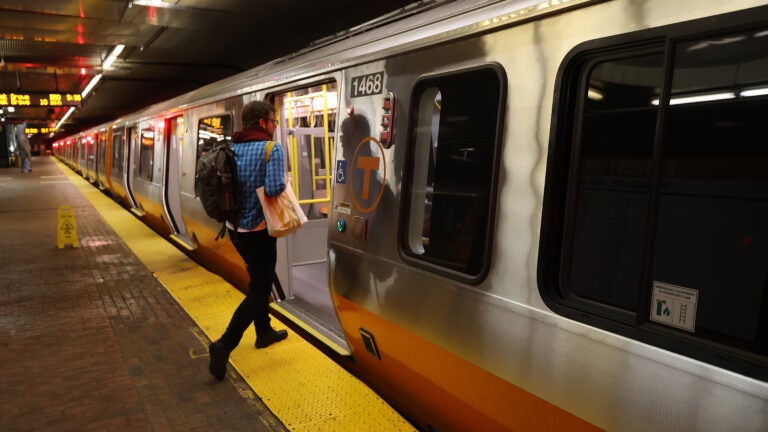
MBTA to further evaluate platform barriers after 19-year-old dies from falling on third rail
The MBTA is developing a "request for proposals" for a pilot program that would add barriers to an Orange Line or Red Line station.
www.boston.com
After a 19-year old was killed when he fell onto an electrified third rail at an MBTA station, MBTA officials are exploring the possible addition of protective platform barriers to some subway stations to prevent similar tragedies.
Lowell resident Frankey Wright died after falling off the platform at Forest Hills Station on Saturday afternoon, according to the Suffolk District Attorney’s office. He was with another person, a 19-year-old woman, who also fell onto the tracks. She was taken to a hospital and remains in critical condition.
[...]
Earlier this year, the MBTA issued a “request for information” about the possibility of adding “transit station platform screen door systems” to stations on the Red, Blue, and Orange lines.
These barriers would need to be capable of “safely, reliably, and effectively screening transit passengers from unintentionally entering the pit area of station platforms when trains are not physically present at the station,” officials wrote in their RFI.
[...]
The MBTA received multiple responses to the RFI, according to spokesperson Joe Pesaturo. Now, the feedback and comments generated by the RFI will be used to issue a “request for proposals” this fall. The MBTA is seeking proposals for a pilot program that would add barriers to a “yet-to-determined Orange Line or Red Line station,” he said. “The pilot will be used to observe a platform barrier’s integration with MBTA infrastructure and evaluate the capabilities and operational effectiveness of such a barrier in the subway system,” Pesaturo said.
Screen doors are not going to happen on the MBTA and that is a good thing. Have the people clamoring for them noticed the extremely tight budget restraints the MBTA is in every year? Where exactly are the billions for installation and maintenance going to come from? Screen doors are not common even in cities with world class transit. And many that do exist would not stop a determined person from jumping over them. The people who steal the subway fare and smoke in MBTA stations will be the same people who deface and break the platform doors. That is something Singapore does not have to contend with because they actually have prevalent common decency and enforce the laws.
If you are truly interested in saving lives then lets electrify the commuter rail which will reduce cancer causing toxic emissions and get some dangerous car drivers off the road and on to public transit.
If you are truly interested in saving lives then lets electrify the commuter rail which will reduce cancer causing toxic emissions and get some dangerous car drivers off the road and on to public transit.

Jahvon09
Senior Member
- Joined
- Oct 2, 2011
- Messages
- 3,419
- Reaction score
- 852
The platform doors should be added to all of the station platforms to eliminate people from falling into the pit for good. Why does it take someone getting killed needlessly for this feature to be added?!!!! It just doesn't make any sense at all!!!!!!

Charlie_mta
Senior Member
- Joined
- Jul 15, 2006
- Messages
- 5,288
- Reaction score
- 8,077
Just stand a few feet back from the platform's edge, and it will be fine.
Jahvon09
Senior Member
- Joined
- Oct 2, 2011
- Messages
- 3,419
- Reaction score
- 852
Just stand a few feet back from the platform's edge, and it will be fine.
As a margin of safety, I do not go anywhere NEAR the edge of the platform until or unless the train comes & stops completely. That's my ruling. At Park Street Under, the third rail is right there at the outside platform. It's not at the middle platform. And when the kids are with me, I tell them to do the same thing!! That way, none of us are in any danger!!
Last edited:
JeffDowntown
Senior Member
- Joined
- May 28, 2007
- Messages
- 5,099
- Reaction score
- 4,376
Some of the old stations, like the extension area at State Blue Line, do not have a few feet from the platform edge available when busy.Just stand a few feet back from the platform's edge, and it will be fine.
Charlie_mta
Senior Member
- Joined
- Jul 15, 2006
- Messages
- 5,288
- Reaction score
- 8,077
Is it technically possible to put covers over the third rail just in the station areas, like the third rails are in the NYC subways?Some of the old stations, like the extension area at State Blue Line, do not have a few feet from the platform edge available when busy.
F-Line to Dudley
Superstar
- Joined
- Nov 2, 2010
- Messages
- 10,104
- Reaction score
- 12,860
That depends heavily on the third rail shoe design of the T's vehicles. Usually systems that have covers have a specific shoe design providing adequate clearance, whereas a lot of systems without covers don't have enough clearance for them with their shoes.Is it technically possible to put covers over the third rail just in the station areas, like the third rails are in the NYC subways?
Third-rail incidents are a minority of track intrusion incidents, however. Most injuries happen from getting struck by the train, not contact with the third rail.
PSDs are quite common on new-builds now, especially in central business districts with busy and constrained platforms. Australia's newest lines, London's Elizabeth,Screen doors are not common even in cities with world class transit.
Retrofits are also becoming common - Paris, Vienna, Glasgow, most major cities in Japan, Singapore, Taibei. You'll be surprised the next time you go abroad how common these devices have become to most daily riders' lives.

TheRatmeister
Senior Member
- Joined
- Sep 23, 2023
- Messages
- 1,626
- Reaction score
- 3,334
They're common in new builds because there is near zero reason not to build your new line automated, and if you're doing that then PSDs make it way easier. I would hestiate to say that retrofits are becoming common though. Retrofitting automation/PSDs is something that even cities like Paris have stumbled on, and those projects have tended to be expensive and prone to cost overruns. PSDs in particular often get omitted from automation retrofits because building them into stations that were never designed for them is really hard.PSDs are quite common on new-builds now, especially in central business districts with busy and constrained platforms. Australia's newest lines, London's Elizabeth,
Retrofits are also becoming common - Paris, Vienna, Glasgow, most major cities in Japan, Singapore, Taibei. You'll be surprised the next time you go abroad how common these devices have become to most daily riders' lives.
But there are alternatives.
New York's fixed barriers have been quite successful, especially for cost obviously.
And Sofia uses an (as far as I can tell) unique system with rolling screens protecting the length of the platform.
I don't think you can say that they're uncommon, either. It's slow going and also generally supported and funded.I would hestiate to say that retrofits are becoming common though.