
TheRatmeister
Senior Member
- Joined
- Sep 23, 2023
- Messages
- 1,539
- Reaction score
- 3,093
No idea is ever original is it
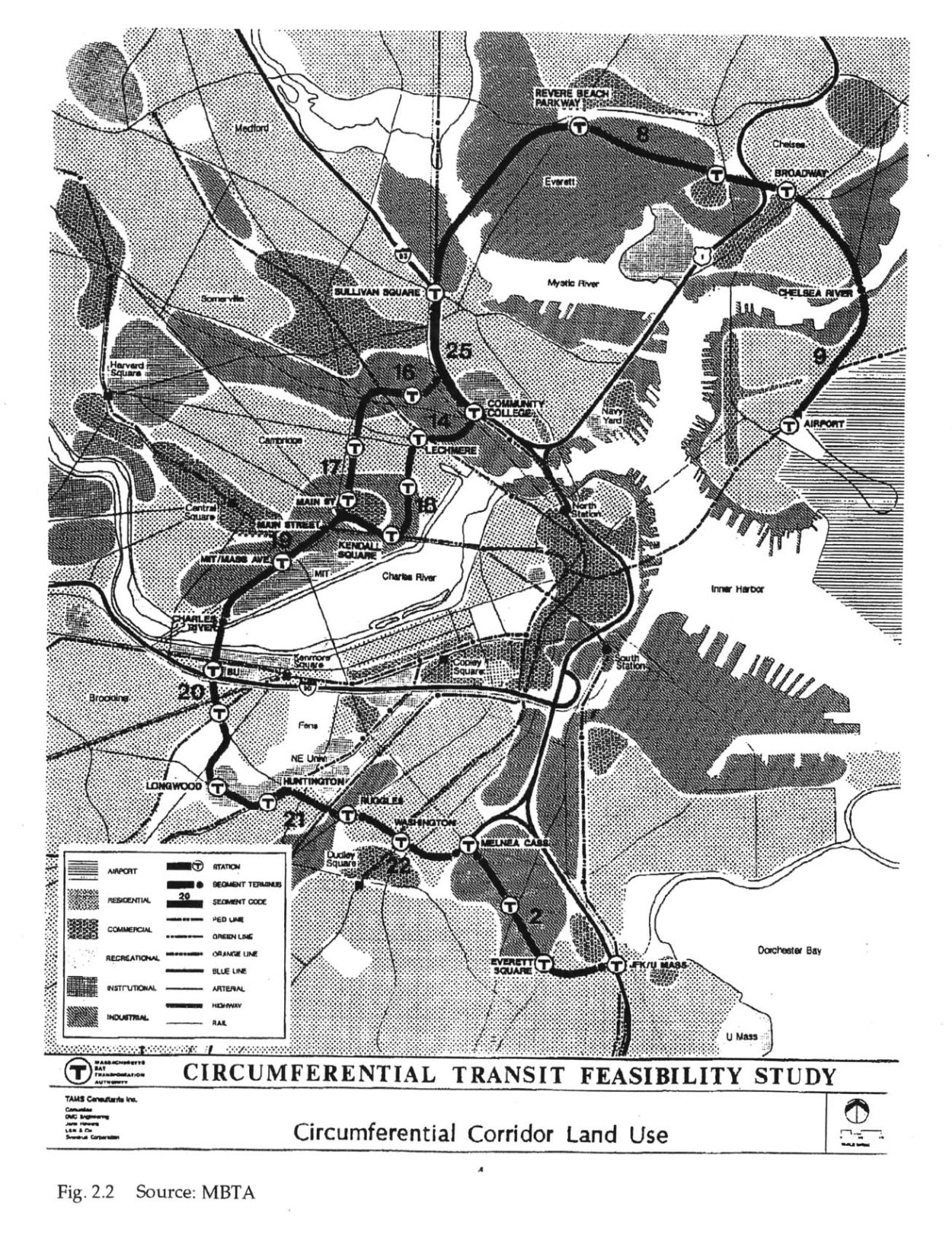
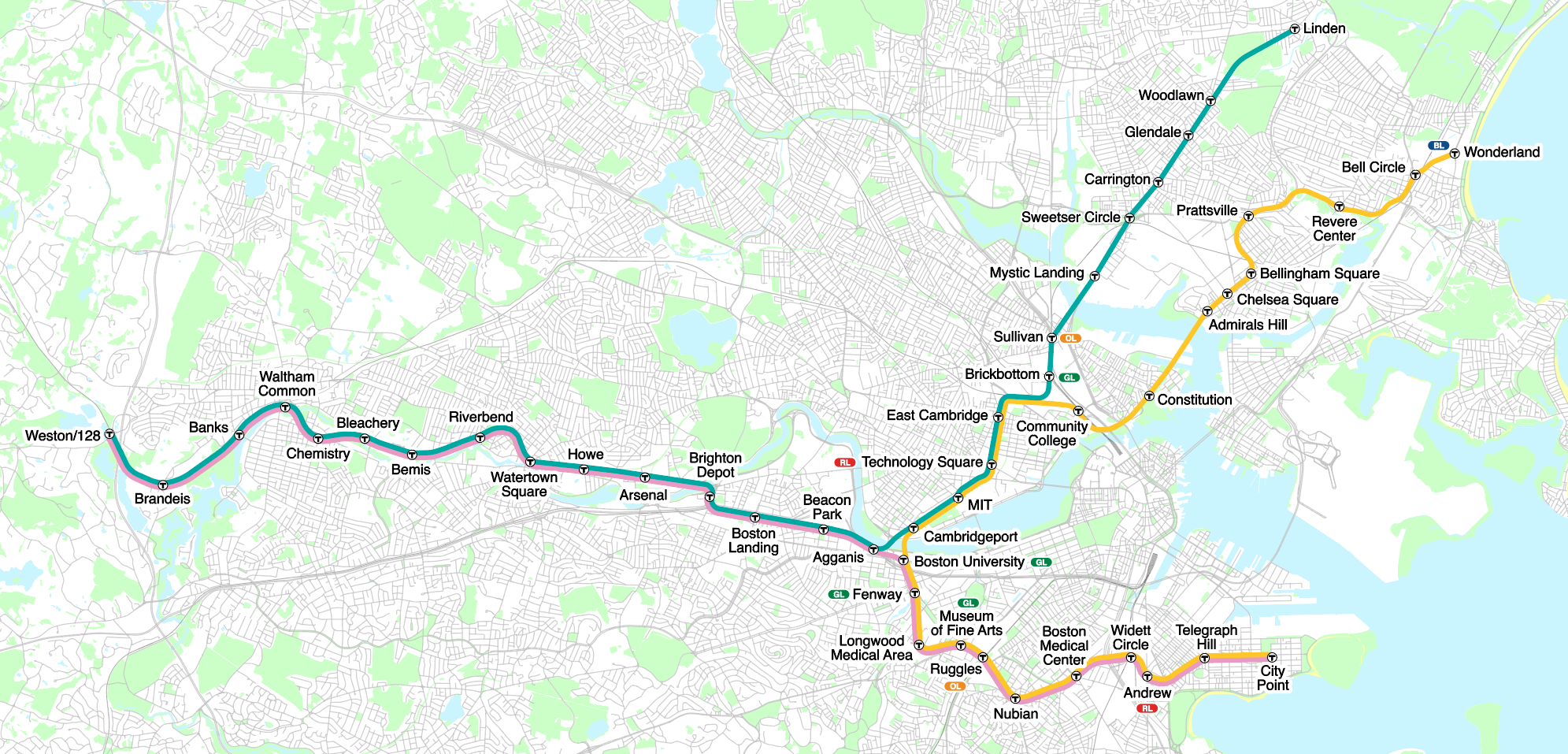


I like the idea shown on the first graphic of the Urban Ring on an easterly alignment along First Street, lining it up directly with the Kendall, Lechmere and Community College stations. My preference for this portion of the route would be elevated LRV.

The real Urban Ring Major Investment Study (BRT version) proposed a branch to JFK.I think after Boston Medical it should not go to Widdet Cir but go south on Mass Ave where it meets the Fairmount at Mass Ave, then to JFK/ UMASS and the commuter rail south, and then follow Columbia Road to City Point. It would serve thousands more people

In my mind, JFK/Umass is very important for the Urban ring and definitely better than Andrew.I think after Boston Medical it should not go to Widdet Cir but go south on Mass Ave where it meets the Fairmount at Mass Ave, then to JFK/ UMASS and the commuter rail south, and then follow Columbia Road to City Point. It would serve thousands more people
The base map is imported into Illustrator from QGIS and then I adjusted the colors on each layer to make it look just right. There's still a little more I want to do with it but it's pretty good. And as you can probably imagine the lines and stations themselves are not complicated.Regardless, the map just looks really nice! How are you making this?
Here's the basic theory in short form:I'm thinking over how well this really works. I'm starting to come around, but I'm working on questions.
I don't know what mode or method was being imagined here, but I'd guess a subway. First St is nowhere near wide enough for an elevated.I like the idea shown on the first graphic of the Urban Ring on an easterly alignment along First Street, lining it up directly with the Kendall, Lechmere and Community College stations. My preference for this portion of the route would be elevated LRV.
Yeah that's something I clearly missed, I also only put Brickbottom on one Northern branch when it should be on both.And I think it would be a little clearer if you label which stations would have transfers to Commuter Rail. Some I think you're implying would be infills, but I'm not sure all.
| JFK+Newmarket Alt | Andrew+Widett Alt | |
| Developable Land | Columbia Point, South Bay Mall, Newmarket Sq area | Andrew, Widett (Expensive air rights), Smaller portion of the Newmarket Sq area |
| Existing Density | Everett Sq (not that one), apartments around JFK | None |
| CR Transfers | Existing stations at Newmarket/JFK | New infill at Widett Circle needed, JFK CR likely closes |
| Travel time from Mass Ave @ Melnea Cass to Broadway @ Dorchester St at 20MPH average speed | ~8.5-9 Minutes | ~4.5-5 minutes |
| Construction cost assuming an El to just short of Everett Sq/Andrew, then tunneled. $1bn/mi for tunnel and $600mn/mi for Elevated | $2.3bn | $1.4bn+$200mn for CR infill |
If Amsterdam and Rotterdam can build metros when the city is below sea level I have no doubt it's possible. Whether it's practical in the context is a different question and when the Grand Junction alignment is (mostly) available I think the answer is no.I agree about First Street not being wide enough for an elevated. However, much of that part of Cambridge from south of Mass Ave up to Lechmere Square is filled-in former swamp, so I don't know how feasible a subway would be. Engineering studies would obviously be needed to determine that.
I followed transit developments like a hawk when I was a kid and a teenager in the 1950s and 60s, and I don't recall seeing any proposals or ideas floated publicly regarding circumferential transit. Also, I'm thinking there probably weren't any in the 1930s because of the Great Depression, and in the 1940s because of WW II.I'm trying to trace back the history of the Urban Ring. The earliest I can find is the Circumferential Transit Report from 1972, which is claimed to be the first full study. Wikipedia and a couple other articles make reference to a 1923 proposal but nobody seems to have a record of what this proposal actually looked like, or if there were any other proposals between 1923 and 1972. (My guess is no given that in later years the BERy and later the MTA were focused on suburban extensions and the GL subway but I could be wrong).
I was wondering if anyone here has been able to find these resources in the past or knows if they even exist at all. The City of Boston Archive has some (undigitized) documents but:
- Those are not particularly accessible to me at the moment
- They seem to be missing material from 1923, when the proposal was (allegedly) made

You're right in that the service pattern here leaves a lot to be desired for Everett, a revision to that is definitely needed. A BL extension would absolutely help with that but I've been trying to keep this scheme independent-yet-complimentary of other projects. I don't want this to be a whole fantasy map, I want a simple, relatively standalone idea, and I don't think it's possible to hit everything while maintaining that focus. You'll need complimentary schemes like the Green Line Reconfig, Mass Ave LRT, 'SL Phase 3 but Green Line', and a new downtown subway to accomplish everything, but even without those I think the map shown achieves most of its goals by itself.Ultimately, I'm not sure that the radial-circumferential combo works well here. A circumferential line is primarily for short-distance trips and connecting places to the radial lines; if you're going far around (such as Chelsea-LMA) it'll be faster to go through the core. Everett riders have to transfer to hit any major employment center aside from Kendall, and everybody has to transfer to hit downtown, Back Bay, and the Seaport. I'm personally a fan of routing Chelsea+Everett through Kendall/Back Bay/Nubian and having Watertown/Waltham be a Blue Line extension.
To focus in on this a little more, this seems like the worst of both worlds to be perfectly honest. You miss adding a circumferential connection, you miss downtown, and, at least from the data publicly available, you don't really benefit by serving a more popular connection. Mass Ave is still right there for an at-grade light rail line to serve this particular niche.I'm personally a fan of routing Chelsea+Everett through Kendall/Back Bay/Nubian
Community College is in direct conflict with the NSRL portal and I'm well aware. I personally think it tilts towards 'worth it' it for the UR transfer but there's a strong argument towards putting a station at Inner Belt instead and then just abandoning the Lowell/Haverhill Lines. Widett Circle seems to be more uncertain, and with the 2019 plans I think it's actually outside the tunnel. (With the 2003 plan though, you're right that's another direct conflict.) I do consider a Fairmount Line transfer to be essential though, so despite the uncertainties with development I think it merits a station regardless.No way you're getting CR stations at Community College or Widett Circle - they'd be within NSRL portals, and both are lousy places for a CR station anyway. Sweetser Circle is on a tight curve for CR, and even if Route 16 got downgraded you're still not getting much density on the wetlands.
There are a few advantages:What's the point of following the Watertown Branch? There are several substantial buildings on the ROW, and the odd-angle crossings would make a surface route nasty. If you're tunneling, seems better to follow Pleasant (or Grove or Main) and avoid the river crossings. It was never a major commuter branch, so there was never the density around the stations that you see on other lines.
My personal preference is to have a BLX via the Esplanade and Kenmore to Waltham on the alignment you show. It would tie the ends of the metro area and Logan together well.You're right in that the service pattern here leaves a lot to be desired for Everett, a revision to that is definitely needed. A BL extension would absolutely help with that but I've been trying to keep this scheme independent-yet-complimentary of other projects. I don't want this to be a whole fantasy map, I want a simple, relatively standalone idea, and I don't think it's possible to hit everything while maintaining that focus. You'll need complimentary schemes like the Green Line Reconfig, Mass Ave LRT, 'SL Phase 3 but Green Line', and a new downtown subway to accomplish everything, but even without those I think the map shown achieves most of its goals by itself.
I think you're probably right though that the value a BL extension adds by 'solving' the western branch is too much to ignore.
To focus in on this a little more, this seems like the worst of both worlds to be perfectly honest. You miss adding a circumferential connection, you miss downtown, and, at least from the data publicly available, you don't really benefit by serving a more popular connection. Mass Ave is still right there for an at-grade light rail line to serve this particular niche.
Community College is in direct conflict with the NSRL portal and I'm well aware. I personally think it tilts towards 'worth it' it for the UR transfer but there's a strong argument towards putting a station at Inner Belt instead and then just abandoning the Lowell/Haverhill Lines. Widett Circle seems to be more uncertain, and with the 2019 plans I think it's actually outside the tunnel. (With the 2003 plan though, you're right that's another direct conflict.) I do consider a Fairmount Line transfer to be essential though, so despite the uncertainties with development I think it merits a station regardless.
There are a few advantages:
I also don't think the river crossings are frivolous or wasteful. The Chemistry is well connected by streets, currently underdeveloped, but also home to a foothold for retail and commercial land uses. It's very well poised to become a dense local center and I think avoiding it would be a mistake. The difficulties of the river crossing are also balanced out by the particularly good state of the ROW there. There is little/no encroachment between Pine Street and Seyon Street, and only six private landowners. There are only two grade crossings on the Waltham side of the river, both of which could be handled with a single cutting feeding into the tunnel under Waltham Center.
- The alignment is (mostly) in-tact. Yes there has been some encroachment, particularly Watertown Mews and around Rosedale Road, but both are pretty avoidable with short mined sections under Pleasant Street. That is the backup for areas where the ROW is too compromised.
- Land ownership. Most of the route is owned and surrounded by a few large commercial landowners, and parts are still publicly-owned. In comparison, Waltham St and Main St are surrounded by hundreds and hundreds of tiny, privately owned owner-occupied homes.
- Those large plots present the opportunity for large-scale, public re-development that could be used to finance the construction of the line.
It's not perfect but I think a cutting/elevated alignment using the Watertown Branch with pretty simple stations is far better value than what you could even hope to get with a new deep-bored ROW somewhere else with deep, expensive stations.
Yeah. Mixing radials and circumferentials within one route rarely works well, and usually underperforms pretty significantly on ridership because of skipping the core the radial riders disproportionately want to get to. Alon Levy has written a lot about that over the years, and still is still writing about it this very week re: IBX in New York and pressure from some advocates to make that circumferential a wee bit more radial.Ultimately, I'm not sure that the radial-circumferential combo works well here. A circumferential line is primarily for short-distance trips and connecting places to the radial lines; if you're going far around (such as Chelsea-LMA) it'll be faster to go through the core. Everett riders have to transfer to hit any major employment center aside from Kendall, and everybody has to transfer to hit downtown, Back Bay, and the Seaport. I'm personally a fan of routing Chelsea+Everett through Kendall/Back Bay/Nubian and having Watertown/Waltham be a Blue Line extension.
I don't know how you would ever get an appropriate-length platform squashed between mission-critical crossovers at Tower A interlocking on the northside and Broad interlocking on the southside. Those are areas of maximum criticality for differing movements with little give for moving the crossovers because of escalating speed restrictions if they get packed any closer. We eventually want to reform the terminal districts so 30 MPH instead of 10 MPH is possible. That's not going to happen if you have to distort switch layouts to fit in platforms at either site. Besides, I'm not even sure how Community College-Purple is supposed to function with extremely high up Gilmore Bridge's extremely tiny sidewalk being the only link to the outside world and the Orange station >500 ft. away. You can barely even double-file on this. It's hilariously inadequate for any sort of egress.Other notes:
- No way you're getting CR stations at Community College or Widett Circle - they'd be within NSRL portals, and both are lousy places for a CR station anyway. Sweetser Circle is on a tight curve for CR, and even if Route 16 got downgraded you're still not getting much density on the wetlands.
- What's the point of following the Watertown Branch? There are several substantial buildings on the ROW, and the odd-angle crossings would make a surface route nasty. If you're tunneling, seems better to follow Pleasant (or Grove or Main) and avoid the river crossings. It was never a major commuter branch, so there was never the density around the stations that you see on other lines.
I don't want this to be a whole fantasy map, I want a simple, relatively standalone idea, and I don't think it's possible to hit everything while maintaining that focus. You'll need complimentary schemes like the Green Line Reconfig, Mass Ave LRT, 'SL Phase 3 but Green Line', and a new downtown subway to accomplish everything, but even without those I think the map shown achieves most of its goals by itself.
I don't think there's a timeline where this makes any logical sense. Along Pleasant and River is underdeveloped today with little streetwall because the ROW is so closeby, so Bleachery right now is not screaming for rapid transit. It only will scream for it if the streetwall first gets developed...which will of course cannibalize the rest of the ROW and force you into the cut-and-cover or deep-bore under the roads at billions more to tap the density. Fast-tracking the transit build shallower under the ROW to lead the afterwards redev by the nose 1900's-style has to first have a mechanism of protecting the ROW, something the cities neglected to do when Guilford was abandoning the Bleachery-west ROW from the 80's to the 2000's. It's not at the starting gates because no feasibility study has ever been commissioned at any point in history...but the second you even *talk* about commissioning a transit feasibility study the real estate market on a speculative transit line is going to immediately go much hotter and the fast-disappearing parcels will be harder to acquire anyway. Damned if you do, damned if you don't...and it's been so long since the state has geared up for any prominent eminent domain fights that they aren't dextrous enough to either wield the hammer fast or and/or act on the down-low fast to control the fast-dissolving ROW. As a function of activity-over-time, anything you do to initiate things here is going to end up dissolving the ROW before your very eyes faster before you get any practical chance to protect it as a subway footprint. Preemptive landbanking really was that important, and they didn't do it on this corridor.It's not perfect but I think a cutting/elevated alignment using the Watertown Branch with pretty simple stations is far better value than what you could even hope to get with a new deep-bored ROW somewhere else with deep, expensive stations.
Slight correction to this: In 1946, the legislature directed the Coolidge Commission to consider a "a subway loop from Boston through Everett, Maiden, Medford, Somerville and Cambridge to Boston and to Forest Hills in the West Roxbury district". That would have been a rather ungainly route:The next major regional transit plans were the Coolidge Commission (1945-47) and the Program for Mass Transportation (1966), which were focused on radial suburban routes, so it does appear that the 1972 study was the next time a circumferential line was seriously discussed.
