Roads and Highways General Development Thread

This bill isn't really to do studies. It's to force DOT and MPOs to actually implement policies based on what we already know. This is using those past studies to actually do something. This looks broadly good (but maybe other people know state gov better could chime in). This is the meat of the bill:


No metropolitan planning organization shall approve a Regional Transportation Plan or Transportation Improvement Program developed pursuant to 23 CFR Part 450, and the department shall not approve a Statewide Transportation Improvement Program, unless the plan or program, including any mitigation measures interlinked to individual projects within the plan or program, provides a reasonable pathway to compliance with the greenhouse gas emissions sublimits for the transportation set pursuant to section 3A of chapter 21N and to the statewide vehicles miles traveled reduction goals established by the secretary pursuant to section 81 of this chapter.

My reading of this was that it is focused on transportation policy/planning, not land use or tax policy, where a huge amount of the possible VMT reduction is hiding.
 
I'm not sure I agree. Just as a general principle, I think bike lanes should go where people need to go, and a bunch of places people need to go are on Eastern Ave. We generally don't tell drivers they can't use a street because there's a nearby, parallel street. Specifically for this stretch, I think skipping bike lanes would be a problem. I'm trying to imagine how someone on a bike would get from the Northern Strand to anything on the south side of Eastern Ave. (businesses or side streets). If there aren't bike lanes on Eastern, it would mean a lot of really circuitous routes/biking in traffic/biking on sidewalks, etc. That's especially true because Eastern has such long blocks.

But there are space constraints, and I'm always in favor of better sidewalks, like you say. I don't really know what will fit.
I agree that bike lanes should be on major streets. On Google Earth, in the western part of the project I measure a width of about 56 ft for the existing Eastern Ave right-of-way (ROW) width, including the existing sidewalks. So, with two 12 ft lanes for vehicular traffic, that leaves 16' each side of the road for an 8' wide sidewalk and an 8' wide protected bike lane, on each side of the road. However, on the eastern segment of the project, Eastern Ave's ROW is only 50' wide (including existing sidewalks), so with two 12' lanes for traffic, that leaves only room for a 6' wide sidewalk and a 6' wide bike lane on each side of the road. Also, looking at Google street view, there is some on-street parking going on along the north side of the street which would have to be eliminated.
 
My reading of this was that it is focused on transportation policy/planning, not land use or tax policy, where a huge amount of the possible VMT reduction is hiding.
I see. Yes, that's fair, this is mostly focused on transportation planning. But it does touch on land use a bit. This says one of the possible policies DOT should be considering for reducing VMT for new projects is "land use, including but not limited to residential and other density increases, mixed-use development, and transit-oriented development." But that's number 7 on a list of 8, and the rest are transportation oriented, for sure.

Transportation and land use really go hand in hand. We have a Department of Transportation, but we don't really have a state Department of Land Use. The state does regulate land use, but across probably dozens of departments. For reducing VMT, it makes sense to stick this in DOT, and it is good the law would have them consider land use. I don't know, this all seems basically positive.
 
I'm totally with you that it looks like a net positive! It just feels performative because there is SO much more that could be done for VMT reduction...

We're not even doing pilot studies on VMT-based taxes like a lot of other states.
 
I'm totally with you that it looks like a net positive! It just feels performative because there is SO much more that could be done for VMT reduction...

We're not even doing pilot studies on VMT-based taxes like a lot of other states.

That's what it sounds like they are talking about. Climate whatever is just their buzzword for how they are going to sell the idea.

I am seeing far too many Teslas out there so perhaps this is also about getting something out of EVs.
 
12 ft lanes
Curious about this. I know there's a push in some places to get away from 12 ft travel lanes. They're fine for highways, but on city streets they just encourage speeding. Any idea what the regulations would be for Eastern Ave? And besides regulations, is there some reason this street specifically couldn't use 10 or 11 ft travel lanes?
 
Curious about this. I know there's a push in some places to get away from 12 ft travel lanes. They're fine for highways, but on city streets they just encourage speeding. Any idea what the regulations would be for Eastern Ave? And besides regulations, is there some reason this street specifically couldn't use 10 or 11 ft travel lanes?
Great point. I looked up the AASHTO guidance on lane width, and I found this verbiage via AI: "AASHTO guidance, primarily from "A Policy on Geometric Design of Highways and Streets" (the "Green Book"), recommends 12-foot (3.6 m) lanes as the standard for high-speed, high-volume, and interstate highways. While 12-foot lanes are preferred, 10 to 11-foot (3.0 to 3.3 m) lanes are acceptable in urban, low-speed, or constrained areas, and 9-foot (2.7 m) lanes may be used on low-volume roads."
I was thinking 12' lanes on Eastern Ave because I had set up only one lane in each direction, with no center turn lane, so I was thinking 12' lanes might be appropriate in that tight of a situation. But I could see putting in two 11' lanes instead, based on the AASHTO guidance cited above. This would open up an extra foot for the bike lane or sidewalk on each side of the roadway.
 
Curious about this. I know there's a push in some places to get away from 12 ft travel lanes. They're fine for highways, but on city streets they just encourage speeding. Any idea what the regulations would be for Eastern Ave? And besides regulations, is there some reason this street specifically couldn't use 10 or 11 ft travel lanes?

Only major E/W route in that region of the metro area besides 16, and the commercial/industrial along some of this area seems to generate a decent volume of heavy truck trips. Not sure if narrower streets are ideal if you're expecting heavy truck trips to be on the corridor regardless.
 
Great point. I looked up the AASHTO guidance on lane width, and I found this verbiage via AI: "AASHTO guidance, primarily from "A Policy on Geometric Design of Highways and Streets" (the "Green Book"), recommends 12-foot (3.6 m) lanes as the standard for high-speed, high-volume, and interstate highways. While 12-foot lanes are preferred, 10 to 11-foot (3.0 to 3.3 m) lanes are acceptable in urban, low-speed, or constrained areas, and 9-foot (2.7 m) lanes may be used on low-volume roads."
I was thinking 12' lanes on Eastern Ave because I had set up only one lane in each direction, with no center turn lane, so I was thinking 12' lanes might be appropriate in that tight of a situation. But I could see putting in two 11' lanes instead, based on the AASHTO guidance cited above. This would open up an extra foot for the bike lane or sidewalk on each side of the roadway.
MassDOT's Project Development and Design Guide is what we use for the design of local roads, being based on AASHTO's Green Book. Roadway design width is based on a host of factors including design speed, setting (urban, suburban, rural), classification (arterial, collector, local), along with potential users such as bicycles.
 
MassDOT's Project Development and Design Guide is what we use for the design of local roads, being based on AASHTO's Green Book. Roadway design width is based on a host of factors including design speed, setting (urban, suburban, rural), classification (arterial, collector, local), along with potential users such as bicycles.
Here's the lane width table from MassDOT's Project Development and Design Guide. It's adapted from the AASHTO Green Book.
I'm leaning towards 12' lanes for Eastern Ave because of the heavy truck traffic, plus no center turn lane (under the scenario with protected bike lanes on both sides).

1776366962809.png
 
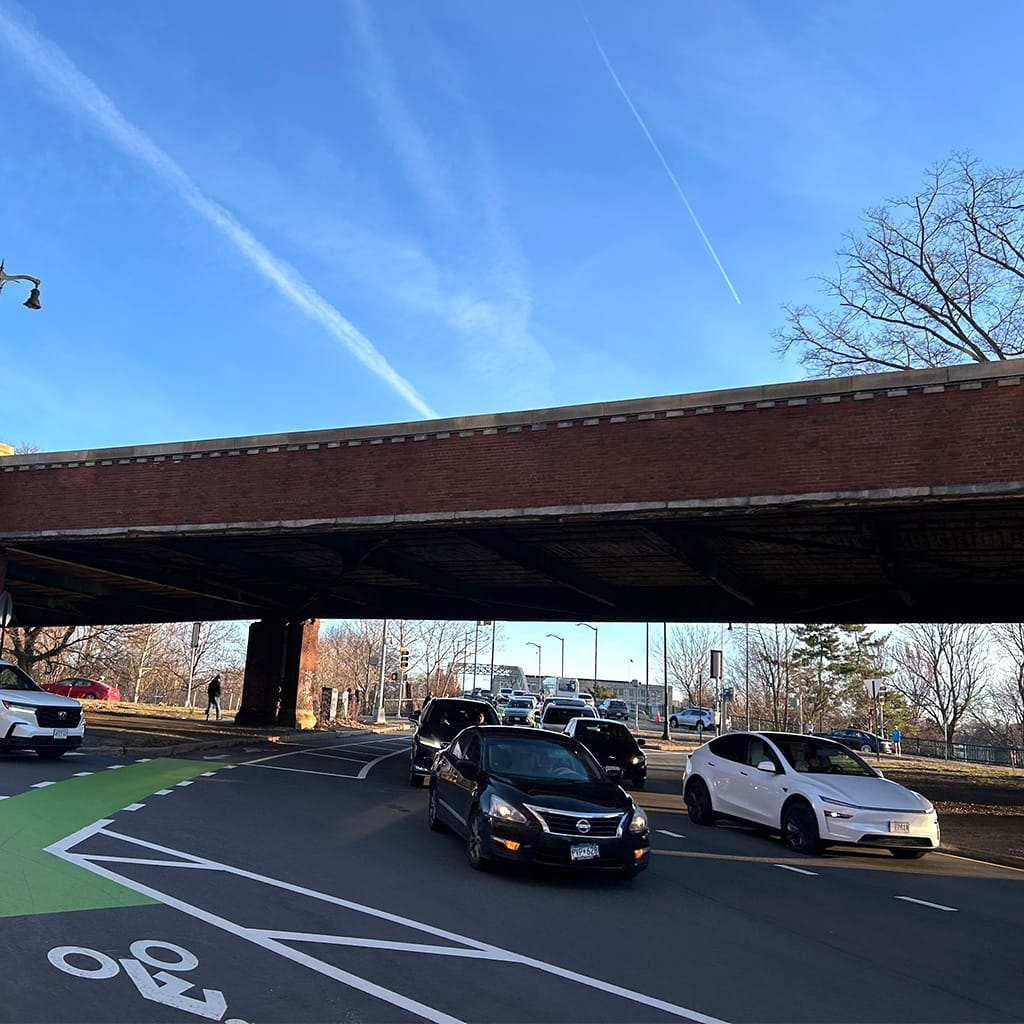
On the Reid Overpass:

 
I agree that bike lanes should be on major streets. On Google Earth, in the western part of the project I measure a width of about 56 ft for the existing Eastern Ave right-of-way (ROW) width, including the existing sidewalks. So, with two 12 ft lanes for vehicular traffic, that leaves 16' each side of the road for an 8' wide sidewalk and an 8' wide protected bike lane, on each side of the road. However, on the eastern segment of the project, Eastern Ave's ROW is only 50' wide (including existing sidewalks), so with two 12' lanes for traffic, that leaves only room for a 6' wide sidewalk and a 6' wide bike lane on each side of the road. Also, looking at Google street view, there is some on-street parking going on along the north side of the street which would have to be eliminated.
I also believe that bike lanes should be on main roads, but Eastern may provide a bit of opportunity for a compromise due to the proximity of US Bicycle Route 1/East Coast Greenway. Because the path is one block off Eastern, it may be possible to do a bike lane along the southern side of Eastern Ave, one-way heading east, and provide ample connection points back to the larger path for westbound travel. There would need to be an increased signage/wayfinding/striping budget to ensure direction and order is maintained, but this could provide a happy medium. We do tell drivers all the time which direction they can travel on a street, so I think it isn't out of the realm of possibility to propose such a compromise.
 
On the Reid Overpass:

From the article: "As with the Allston highway project, Bowker Overpass, McGrath Highway and countless other hack jobs, safety, climate change and community wishes are secondary to increasing vehicle throughput at any cost."
The traffic models will almost always show the need for multi-lane roads and overpasses on projects like this. We need to start considering traffic models as just one of several factors, and not the overruling factor. Unfortunately, MassDOT has failed to do this.
 
I have obtained another email from the project team to share.
Thank you for your email and your interest in the Reid Overpass Replacement Project. As you may be aware, the Reid Overpass dates from the 1940’s and is coming to the end of its useful life. During its 80-plus years of service, the ramps and supports of the structure have largely locked the rotary below the overpass in place, rendering safety improvements in the intersection incremental rather than systemic. MassDOT views the need to replace the Reid Overpass as a chance to fundamentally reconfigure the intersection of the Boston University Bridge, Brookline Street, and Memorial Drive so that it can serve all modes in greater safety and comfort. As we take advantage of this opportunity, we need to recognize this is an intersection with many demands on it. At the same time this is an important node in the area’s walking and cycling network, the Boston University Bridge is one of the two river crossings closest to Fenway Park, and this is one of the busier sections of Memorial Drive given the shopping plaza directly to the west of the intersection.

That said, since the January 6th public information meeting introducing the project, MassDOT’s design team has been integrating all of the comments we have received both from individuals such as yourself as well as organized advocacy groups to refine the concepts presented at the beginning of the year. The result of that work has been the development of two new at-grade concepts, and one which includes a bridge. All three of these concepts focus specifically on things the community has asked us to do: tightening the radii of turns and placing them under signal control, presenting a replacement version of the Reid Overpass which only includes one lane in each direction, and working to create more intuitive, protected pathways for cyclists and pedestrians. During the first full week of April, we obtained new traffic counts for all modes with all area schools and institutions of higher education in session. Over the next several weeks we will be rerunning the models for our refined concepts to determine the feasibility of removing lanes from the cross-sections of Memorial Drive and/or Brookline Street to shorten crossings for cyclists and pedestrians.

With regard to some of the specific points that you have raised:
  • Our team is aware of the concept you shared from the community advocate who uses the pseudonym Picoplaff. She has a newer version of it which she has shared with the team which we are analyzing now along with our own refined concepts using the 2026 traffic data.
  • Our team is looking into the feasibility of various bypass options for the Paul Dudley White path, including going under the Boston University Bridge, or flying over its lanes. There are geometric challenges to both, and in the case of the tunnel option permitting and possibly security challenges with the MWRA pumping station, but we are committed to at least following the trail where it leads us and providing a response to the community.
  • Coordination with the MBTA is ongoing. As part of this project, we will be replacing the bridge which carries Memorial Drive over the Grand Junction Railroad line. Based on coordination with the agency and input from the community, we are looking to increase the height and width envelope around the Grand Junction to allow for a second track in the future plus a shared use path. Our project will not build a path or second track, but we will remove an obstacle to their future implementation. Once we determine whether we will put back a bridge or process all movements at-grade, we will be looking at how we can best speed MBTA buses through this intersection.
  • Our refinements have put significant thought into how cyclists and pedestrians come off the Boston University Bridge and interact with vehicles. All of our concepts tighten the northbound right turn to a greater or lesser extent and place it under signal control. Our team is aware that current conditions cause many cyclists coming off the Dudley White Path and seeking to go south into Boston do so on the bridge’s downstream sidewalk. This puts them in conflict with pedestrians and on the wrong side of the intersection when they get to Boston. As such, our concepts set up the crossing of the Boston University Bridge’s lanes to be accomplished by cyclists in one move to make crossing the river on the upstream side easier and more attractive. On the bridge’s northeast quadrant where a number of flows of cyclists and pedestrians converge, we are looking at a variety of treatments from bicycle roundabouts like the one in Forest Hills to mixing zones with special pavers.

Once we have had the opportunity to run our models again with the new 2026 data and chase down a few loose ends like the feasibility of a bicycle underpass at the north end of the Boston University Bridge, we will come back to the community to share our refined concepts and take additional public comment.

Summary:
- Right turn from BUB to Memorial Drive is now signalized like it is now
- Presenting an option for one lane in each direction on the overpass
- They are claiming to be reviewing the concept here which imo has the very clever idea of rerouting the 47 with it's own left turn lane across traffic instead of sending it across the rotary.
- Replacing the GJ overpass section with width for 2 tracks + path (likely to blow up the cost of the project but it's cool)

I would encourage people to continue attempting to contact the project team if you are concerned about the outcome of this project.
 
I have obtained another email from the project team to share.

Summary:
- Right turn from BUB to Memorial Drive is now signalized like it is now
- Presenting an option for one lane in each direction on the overpass
- They are claiming to be reviewing the concept here which imo has the very clever idea of rerouting the 47 with it's own left turn lane across traffic instead of sending it across the rotary.
- Replacing the GJ overpass section with width for 2 tracks + path (likely to blow up the cost of the project but it's cool)

I would encourage people to continue attempting to contact the project team if you are concerned about the outcome of this project.
My goodness, someone put a lot of work into that page. Kudos to them. The idea of rerouting the 47 directly to Mem Drive alone makes this worth consideration.

Worth remembering the story of the all-at-grade alternative for Allston - concepts from the community can win the day when they're presented with justification...
 
I have obtained another email from the project team to share.

Summary:
- Right turn from BUB to Memorial Drive is now signalized like it is now
- Presenting an option for one lane in each direction on the overpass
- They are claiming to be reviewing the concept here which imo has the very clever idea of rerouting the 47 with it's own left turn lane across traffic instead of sending it across the rotary.
- Replacing the GJ overpass section with width for 2 tracks + path (likely to blow up the cost of the project but it's cool)

I would encourage people to continue attempting to contact the project team if you are concerned about the outcome of this project.
The 'compact “Alternative C”' isn't bad. I like the multi-use path continuing onto the overpass.
 
Since this is a ground up project, if there is a path on the bridge, it could easily be separated by use of physical barriers similar to that which was used on the north washington street bridge
 
I really like this proposal (the "Alternative C"). Though I wonder if it would be doable to add an elevated ramp from the bike lane on the overpass to the upstream side of the BU Bridge, eliminating the need for the light where the path crosses the BU Bridge traffic at grade.
 

Back
Top