Fairmount Line Upgrade

I just got burned by this reduction in service. Keolis updated its Fairmont Line schedule to reflect these changes in the June 2 update, but failed to make these same changes to the Readville-South Station timetable, even though it is also dated June 2.
 
1000057991.png
1000057994.png
1000057997.png

Stadler BEMUs, British ROSCO Rock Rail doing the buying. Whole project now well over budget and behind schedule. The previous timeline below, looks like about 3 years behind at this point:

1000058000.png
 
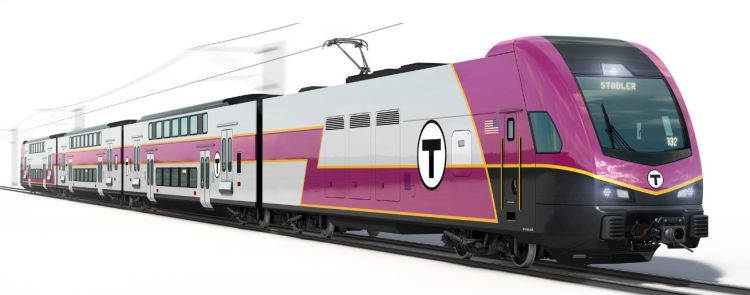
This is probably the train we will see here, plus MBTA specific modifications.

It won't be a Stadler FLIRT; they're low- and middle-high platform only. The only adaptation of it that gets even sorta close (and even then not totally) to 48-inch boarding heights is a British customization that does raised ends and stairs down into the middle seating area...totally inappropriate for here.

EDIT: It's the Caltrain-mod bi-level KISS BEMU that Caltrain is buying as a demonstrator for the San Jose-Gilroy shuttle. 4 cars total: 3 passenger cars + 1 battery car. Low-level doors even though Fairmount and Readville are the only low-level platforms, because we're being forced to swallow the Caltrain dual-platform height mods to get anything from them. Caltrain's single demonstrator is $80M for the 4-car set, so I'm almost scared to think what this is going to cost us.
 
Last edited:
at least 3 years delayed and still no sign of high level platforms at fairmount or readville
Relocated double-track Readville is a requirement for the "future possibility of 15-minute service" that the slides talk about, because they need to be able to berth 2 trains at once to gain acceptable padding to do sub-20 minute frequencies at the turnback. So these BEMU frequencies, while good, are still longer than definitionally qualifies as "Show Up And Wait" service. There's no plans whatsoever to redo Readville or raise the Fairmount platforms, so they are still not delivering on the 15-minute service promises of the Indigo Line DMU proposal from 12 long years ago.
 
Last edited:
EDIT: It's the Caltrain-mod bi-level KISS BEMU that Caltrain is buying as a demonstrator for the San Jose-Gilroy shuttle. 4 cars total: 3 passenger cars + 1 battery car. Low-level doors even though Fairmount and Readville are the only low-level platforms, because we're being forced to swallow the Caltrain dual-platform height mods to get anything from them. Caltrain's single demonstrator is $80M for the 4-car set, so I'm almost scared to think what this is going to cost us.
And anybody with a wheelchair will still need to use the high-level doors along the whole Fairmount Line, because wherever you're going to or coming from is going to have all high-level platforms.
 
And anybody with a wheelchair will still need to use the high-level doors along the whole Fairmount Line, because wherever you're going to or coming from is going to have all high-level platforms.
Plus I don't even think Fairmount's and Readville's low platforms are 8 inches above the railhead to begin with like all of Caltrain's stops are, so the onboard bridge plates from the low-level doors probably wouldn't reach down to an acceptable ADA interface to begin with. The mini-high is still the only 100% accessible way to enter. The T might not even be legally allowed to use the expensive-ass low-level folding bridge plates that these things come factory-installed with.

The T should've requested complete deletion of the low-level doors and installation of standard door traps in the high-level doors, because the boarding procedure is ultra-confusing for only those two outlier stops (and the doors get orphaned completely if those two stops ever get their platforms raised). That would completely undo the Caltrain mods and allow them to use a cheaper stock European import. The low-level doors also delete so many seats that the T indicated in the meeting that their capacity is far too low to ever use them on Providence...so we get the worst of all worlds: bi-levels and no faster-loading flats on Fairmount where station dwells should ideally be the shortest, but bi-levels that are way too small to use on any of our bi-level loading lines. But exactly like with the EMU RFP of several years ago Stadler is trying to recoup the onerous modification costs for Caltrain with unit sales of those unicorns and refused to bid anything else. It was take the Caltrain version or leave it entirely.
 
It won't be a Stadler FLIRT; they're low- and middle-high platform only. The only adaptation of it that gets even sorta close (and even then not totally) to 48-inch boarding heights is a British customization that does raised ends and stairs down into the middle seating area...totally inappropriate for here.

EDIT: It's the Caltrain-mod bi-level KISS BEMU that Caltrain is buying as a demonstrator for the San Jose-Gilroy shuttle. 4 cars total: 3 passenger cars + 1 battery car. Low-level doors even though Fairmount and Readville are the only low-level platforms, because we're being forced to swallow the Caltrain dual-platform height mods to get anything from them. Caltrain's single demonstrator is $80M for the 4-car set, so I'm almost scared to think what this is going to cost us.
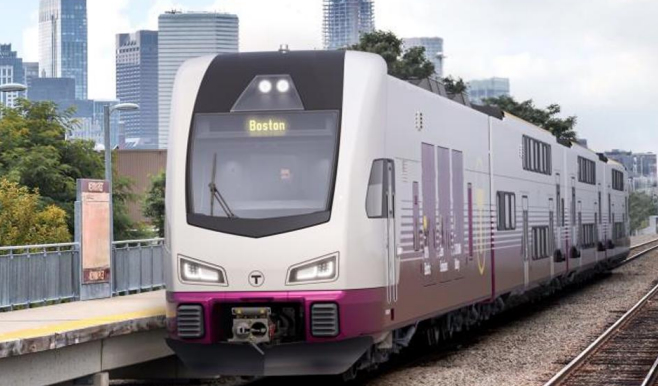
Isnt that what theyve been showing in the renders?

KQFW393XA6C838L4.jpg
 
Isnt that what theyve been showing in the renders?

KQFW393XA6C838L4.jpg
That render is of a Caltrain-mod (i.e. both high- and low-boarding doors) Stadler bi-level KISS BEMU. That exact make is what they're leasing for Fairmount.

The Stadler FLIRT is a single-level car instead of a bi-level, but the floor height is low so its doors can't board at Northeast U.S. 48-inch high platforms. DMU versions of it are in use with western U.S. commuter rail agencies that have exclusively 8-inch platforms and Metra has bought a BEMU version...but they can't physically be used here.
 
1780034821895.png


You know, this paint job thing is really starting to piss me off. First, it was the CRRC orange + red line cars: acceptable, but not excitingly modern. Then the green line type 10s: obviously dated and far from something you could call beautiful.

And now this. WTF are these stripes. I know it's a preliminary design, but WHY can't we just have clean, modern looking trains like SEPTA or Caltrain?
 
View attachment 72965

You know, this paint job thing is really starting to piss me off. First, it was the CRRC orange + red line cars: acceptable, but not excitingly modern. Then the green line type 10s: obviously dated and far from something you could call beautiful.

And now this. WTF are these stripes. I know it's a preliminary design, but WHY can't we just have clean, modern looking trains like SEPTA or Caltrain?
Yea a new livery just so happened to drop today.

BEMU-exterior-credit-MBTA-and-Stadler.jpg


“Director Chandra Smart asked how long the batteries were expected to last.

“We’re looking at 8 years,” said Sawers. “That’s the current provision. However, a lot of the experience recently with the same kind of chemistry is, actually, they last a lot longer than that. So, we’ve provided for the worst case, and that’s the basis of the warranty, and there’s a fund that’s built up to pay for that.””

8 years would be absolutely horrendous if that ends up being the case. The good thing about OCS is it lasts way longer than that, up to 40 years. Maybe the silver lining to this whole thing will be that in 8 years if its already time to refurb the trains they will finally get the point.
 
Last edited:
Relocated double-track Readville is a requirement for the "future possibility of 15-minute service" that the slides talk about, because they need to be able to berth 2 trains at once to gain acceptable padding to do sub-20 minute frequencies at the turnback. So these BEMU frequencies, while good, are still longer than definitionally qualifies as "Show Up And Wait" service. There's no plans whatsoever to redo Readville or raise the Fairmount platforms, so they are still not delivering on the 15-minute service promises of the Indigo Line DMU proposal from 12 long years ago.
Thanks, I kind of figured that was the (major) barrier. I sort of understand that Readville is a much bigger and more complicated situation, but to my eyes Fairmount seems so simple and it’s the terminus of zone 1A. I cant understand an excuse for not getting the ball rolling on high platforms there.

As a daily rider I frequently see problems aligning cars with the mini-high. Inbound, sometimes they just miss it, which is bad, but outbound is a whole nother ballgame. 9 times out of 10 you can count on the second doors from the front stopping at the mini, but that other time is often a disaster. Since all the stops before Fairmount have high platforms, there’s no way as a rider of knowing in advance which doors will be used at the mini (aside from vague and too-quiet intercom announcements, sometimes). So when they miss their mark or are short a conductor, or do something otherwise unexpected, you end up having to sprint across 1 or more cars at the last second to find the right doors. For me it’s an annoyance, but for people in wheelchairs, or with strollers, bikes, scooters, etc it’s devastating. And they often end up at Readville.
 
The T should've requested complete deletion of the low-level doors and installation of standard door traps in the high-level doors, because the boarding procedure is ultra-confusing for only those two outlier stops (and the doors get orphaned completely if those two stops ever get their platforms raised). That would completely undo the Caltrain mods and allow them to use a cheaper stock European import. The low-level doors also delete so many seats that the T indicated in the meeting that their capacity is far too low to ever use them on Providence...so we get the worst of all worlds: bi-levels and no faster-loading flats on Fairmount where station dwells should ideally be the shortest, but bi-levels that are way too small to use on any of our bi-level loading lines. But exactly like with the EMU RFP of several years ago Stadler is trying to recoup the onerous modification costs for Caltrain with unit sales of those unicorns and refused to bid anything else. It was take the Caltrain version or leave it entirely.
Just to be clear, it seems that these trains will be significantly less accessible than single level coaches with all high-level doors. The only "accessible" trip someone can make with the low-level doors would be Readville to Fairmount, which should be a vanishingly small portion of trips. Otherwise, a limited mobility rider will be trapped in the lower level and need significant assistance to get out. The same is true if they board at the wrong mid-level at a full-high station, and end up not aligned with a mini-high at their destination. For single level trains, anyone can roll/walk all the way through preventing these sorts of problems. Despite all of the poor electrification & Regional Rail decisions to this point, this still feels like a new low. Even if Stadler is giving the T time & cost concessions (hypothetically, there's no evidence of this) for trains they couldn't otherwise sell, this is still extremely bone-headed.

On a side note, it's a little surprising to see that there is still no commitment to make every CR station fully high-level as part of Regional Rail. I know much of that has to do with an inability to rein in costs, but it would make decisions like this and future planning so much simpler. It's also an easy political win that sends state money to medium-sized projects in towns all over Eastern Mass.
 
Just to be clear, it seems that these trains will be significantly less accessible than single level coaches with all high-level doors. The only "accessible" trip someone can make with the low-level doors would be Readville to Fairmount, which should be a vanishingly small portion of trips. Otherwise, a limited mobility rider will be trapped in the lower level and need significant assistance to get out. The same is true if they board at the wrong mid-level at a full-high station, and end up not aligned with a mini-high at their destination. For single level trains, anyone can roll/walk all the way through preventing these sorts of problems. Despite all of the poor electrification & Regional Rail decisions to this point, this still feels like a new low. Even if Stadler is giving the T time & cost concessions (hypothetically, there's no evidence of this) for trains they couldn't otherwise sell, this is still extremely bone-headed.

On a side note, it's a little surprising to see that there is still no commitment to make every CR station fully high-level as part of Regional Rail. I know much of that has to do with an inability to rein in costs, but it would make decisions like this and future planning so much simpler. It's also an easy political win that sends state money to medium-sized projects in towns all over Eastern Mass.
I believe part of the rationale at least is that these are intended to "roam" the system and other lines, and operate at least some amount as a proof of concept and pilot on other lines where mini highs or low level platforms are more common. TBD how That'll happen in practice.
 
Just to be clear, it seems that these trains will be significantly less accessible than single level coaches with all high-level doors. The only "accessible" trip someone can make with the low-level doors would be Readville to Fairmount, which should be a vanishingly small portion of trips. Otherwise, a limited mobility rider will be trapped in the lower level and need significant assistance to get out. The same is true if they board at the wrong mid-level at a full-high station, and end up not aligned with a mini-high at their destination. For single level trains, anyone can roll/walk all the way through preventing these sorts of problems.
The problem is the T backed itself into somewhat of a corner with this convoluted outsource+lease arrangement, such that Stadler was most likely the only manufacturer that could meet all the requirements because of the available Caltrain and Metra BEMU orders for tack-ons. None of the other 4 vendors who participated in the T's prior BEMU RFP have any ongoing domestic orders and would have to trigger new procurements that were beyond the scope of this lease deal. Well, the FLIRTs that Metra is ordering, as previously described, are 8-inch platform only. That leaves the extremely expensive unicorn dual-door Caltrain-mod KISSes as the one and only feasible make for lease. Which doesn't, per the board presentation, even work for expanding the fleet to the Providence Line because the number of seats deleted on the lower level puts them too far below the Providence Line's loading (they're 2 x 2 instead of 3 x 2 seating, so already lower-capacity than a Kawasaki/Rotem bi-level coach). They're totally bespoke to Fairmount. I doubt they could even justify expanding this procurement to any other lines within the term of the vendor support because the loading issue is so thorny with only 3 passenger cars per set to work with (and no pass-thru between cab cars so it's not like you could lash 2 sets together), so it's likely going nowhere else.

As I mentioned in the prior post, Fairmount's and Readville's platforms aren't even raised 8 inches above the railhead like Midwestern and West Coast ADA platforms are, so the automatic stowaway bridge plates at the low-level doors most likely can't reach the full ground level with an accessible interface to begin with. The design of the stowaway bridge plates was the major cost bloater for the Caltrain mods, as Stadler had all kinds of trouble designing a folding or sliding mechanism that could even reach a standard 8-inch platform with ADA-spec slope and had to move lots of carbody components to make the bridge plate long enough. So the only way to likely do an accessible Readville<->Fairmount trip is from mini-high platform to mini-high platform, which requires that any person with accessibility needs for alighting at either of those two stops stay in the SOUTHERNMOST car at all times (and how does that even work unless the battery car is ordered to always face NORTH every trip?).

Despite all of the poor electrification & Regional Rail decisions to this point, this still feels like a new low. Even if Stadler is giving the T time & cost concessions (hypothetically, there's no evidence of this) for trains they couldn't otherwise sell, this is still extremely bone-headed.
I've been sounding the alarm all along that their brains are absolutely cooked on battery magic, and that the results were going to be very bad and immensely harmful to any further Purple Line decarbonization and/or Regional Rail-ification efforts. What we're seeing now with the monumentally stupid battery loco purchase that consigns the Providence Line to another generation of half-assed push-pull service and now this artificially constrained BEMU make is reality starting to smack them in the face. Nevermind that we haven't even gotten cost figures for 7 KISS BEMU sets yet to see if they're going to be as apocalyptically over-expensive as the $80M Caltrain demonstrator. What they're trying to do with each procurement is so insanely bespoke that the market is woefully unprepared to deliver anything but bad compromises at hyper-inflated cost. And Eng and Mike Muller and their spox are just "posting through it" so-to-speak with the same delerious overoptimistic talking points...until?...the full cost of all this bespokeness comes home to roost. Which it probably will soon when the full cost package for the vehicle lease is tallied up and people start blowing a gasket over that.

On a side note, it's a little surprising to see that there is still no commitment to make every CR station fully high-level as part of Regional Rail. I know much of that has to do with an inability to rein in costs, but it would make decisions like this and future planning so much simpler. It's also an easy political win that sends state money to medium-sized projects in towns all over Eastern Mass.
On the one hand, it's a little hard to justify raising platforms that already have the ADA-compliant mini-highs when there are so many totally non-accessible platforms left on the system. The agency is in a legit tough spot with that, as the Mass Architectural Board is very inflexible with them about spending scarce resources to upgrade already-compliant stations without tending to the backlog of totally non-compliant stations. The only reason the politically loaded Foxboro full-high renovations got done is because there are so many temp mini-high installations in the queue to beat back some of the non-accessible backlog with measureable progress. But the temp mini-highs don't have a particularly long shelf life before their decay leaves stops inaccessible again, so the agency is in a world of hurt trying to plan up and fund permanent solutions systemwide that would allow them to then pivot to upgrading the already law-compliant mini-high stations to better full level boarding.

This then slams head-first into the runaway cost inflation that station projects are seeing. We're spending 3x or more as much as we were in the 2010's to get basic platform raisings done, and the T is faring worse than a lot of other agencies at cost control because their internal project management oversight was so decimated by the Baker/Pioneer Institute years that they're just hemorrhaging soft contractor costs on every single project instance. And they're not coping with it well, since the first cost-control move they've tried to make en masse is ignoring their own design standards to slash platform lengths below their respective lines' loading minimums like the asinine 4-car/400 ft. Worcester Line Newton platforms that don't work for the 5-7 car trains that dominate the schedules. The dwell times are likely to be even worse at peak that they currently are with low platforms...and it doesn't even save them a whole ton of money to wreck their ops in that fashion. But they're so desperate and have so little semblance of a systemic plan that these are the kinds of unforced planning errors you get. If Readville and Fairmount full-highs went into design right now today, we'd probably be getting no more than 3-car platforms to match the 3 passenger cars of the KISS sets and not one inch more to keep every >4 car Foxboro local from completely hosing all schedules with their ruined dwells.

Unforced errors. On electrification. On procurements. On accessibility. On basic cost control. The planning rot is starting to get exposed in the Commuter Rail division as they face a lot of big existential decisions for the future. And unfortunately that's just going to create generational trauma in T management from trying to mount any further major modernization initiatives. I wish I could be less bleak about the future of Regional Rail, but the signs of implosion are all there in how they're choking away these big systemic planning efforts.
 
Last edited:
I believe part of the rationale at least is that these are intended to "roam" the system and other lines, and operate at least some amount as a proof of concept and pilot on other lines where mini highs or low level platforms are more common. TBD how That'll happen in practice.
It most likely won't happen in practice. These sets don't have any pass-thru doors in the cabs, so it's not like you could lash them up end-to-end with the battery cars aligned to the extremes and come up with a "normal"-loading 6-car passenger set. Staffing requirements alone for two halves of a consist walled off from each other would make that a bad ops value. And the presentation already said they weren't considering these for Providence because of the per-car seating deficit with the lower-level doors wiping out several rows. Plus all the prior gobbledygook they sprouted about the much slower push-pull battery locos being "better" for traditional-length runs. The odds that any of the options for 96 more cars/24 more sets get drained within the fairly short term of this lease are absolutely microscopic. I couldn't even see 3 passenger cars being adequate for the Needham Line's loading given the Ruggles+BBY overlap and bigger peak-period swells with the line's hemmed-in frequencies.

Plus, again, there's almost certainly no legal "accessibility" on the low-level doors because their bridge plates won't reach ground level, only a platform raised at least 8 inches above the railhead...which we don't have on the East Coast. I'm not even sure what the plan is for the step interface with our ground-level platforms; it's a standard-size step up from a standard 8-inch platform to get onboard, but something like a 14-inch step up from ground level which means either these things have to have one step grafted onto the carbody (which the renders don't show) or else the low platforms at Fairmount and Readville will have to have be equipped with portable step stools or risers set up at the door positions to allow the low-level doors to open at all. The only reason the T bought this configuration is because they had no choice: Stadler wouldn't offer one with the high-level doors having door traps and steps for non-accessible low-level compatibility. They didn't offer it in the BEMU RFP of a few years ago, and they didn't offer it in this lease deal. They took a bath trying to shoehorn the Caltrain low-door mods into their standard packaging, and are simply trying to recoup those costs with more unit sales of the Caltrain-default passenger cars. That's the be-all/end-all of this: a take-it-or-leave-it deal, with no other procureable option.


EDIT: The Caltrain-spec KISS BEMU only has 280 seats spread across its 3 passenger cars. That's an average of 93 seats per car, with different tallies for each car depending on operator's cab and bathroom placement + a few seats taken in the powered vs. unpowered cars for fitting in the electronics. The 7-car Caltrain straight EMU seats 675 (~96 per car). That's a pretty big capacity drop for the Purple Line, and probably will only work for the Fairmount Line's flattish all-day loading profile. Kawasaki/Rotem bi-levels seat anywhere from 173-185 people depending on cab car, bathroom trailer, or non-bathroom trailer configurations, and single-levels seat 88-127 (the 2x2 seating MBB trailers seating the smallest). That's definitely going to be a problem with loading on the suburban lines, as an eight-car bi-level Providence Line rush-hour train can seat up to 1425 people, more than twice that of a seven-car Caltrain EMU. And it's not like 2x2 vs. 3x2 seating is the be-all difference here. 2x2 seating NJ Transit MultiLevels seat 110 in an EMU power car, and 130-142 in the trailers and cab cars for not too big a reduction over 3x2 (I actually think we should go to 2x2). The KISSes have a legitimately weird seating layout with some 2x2, some longitudinal where electrical components take up side space, and very large standee areas. Perfectly fine for Fairmount, but I honestly don't know how we'd ever standardize on something that capacity-limited for the elasticity of loading profiles across the Purple Line. We'd have to order something totally different--or at least a KISS with radically different seating configurations than Caltrain ordered--to make them portable to most other lines. And that just means piling bespoke fleets on top of bespoke fleets.

What are we even doing here? :(
 
Last edited:
Tangential, but does anyone know if a map or list exists of the CR stations that indicates platform length as well as which ones are full-high, mini-high, or low platform?
 
Tangential, but does anyone know if a map or list exists of the CR stations that indicates platform length as well as which ones are full-high, mini-high, or low platform?
No. Generally speaking, if it's a full-high it's a rote 800 ft. (9 cars) long because that's the default Design Standard adopted by the T in the 1980's and enforced by the Mass Architectural Board. With the 3 Amtrak NEC stops in T territory and some South Station platforms being 1050 ft. (12 cars) long because some Northeast Regionals run that long.

The only permanent full-highs built less than that were either:
-- Built before the adoption of the Design Standards (2: Malden Center and Oak Grove, built in 1975 to Orange Line 400 ft. length because they were explicitly designed for future conversion to an extension of the OL third express track)
-- Have hardship exemptions because of physical blockers. This currently only impacts the North and South Station terminals due to sheer number and spread of platforms (South Station Old Colony platforms are pinned in to 600 ft. by the USPS/Fidelity side of the complex, and several North Station platforms are pinned in to 600-700 ft. by the tight drawbridge approach)
-- Cape Flyer stops (e.g. 400 ft. Wareham Village), built before the service was made permanent so done on a shoestring budget with generally wood materials

There are 2 "temporary" 200 ft. full-highs built on freestanding blocks: Lynn Interim and North Wilmington. But Lynn Interim is obviously an emergency situation, and N. Will has questions about whether it will even be serviced at all in that location (as opposed to the ex-Salem St. stop on the Wildcat Branch) when thru-Haverhill service vacates the Reading Line in the Rail Vision. Both structures have a maximum shelf life of 10-15 years tops.


Obviously they are trying now to lean very hard into hardship exemptions to cut costs on future full-highs by shorting their length, but to date no shorties have actually been built in the Design Standards era at intermediate regular-service stops with an exemption. Even Lawrence Station, which only has 680 ft. of "active" platform, was fully built with a 120 ft. incomplete paved platform section to the full 800 ft. (the 120 ft. section just needs its platform edging installed, which they just haven't been in any hurry to do).


All mini-highs, permanent or newfangled freestanding temp ones, are 1-car only...so 85-100 ft. tops. Low platforms--on both the mini-high and non-accessible stops--vary by length almost individually because they either predate the Design Standards or were subject to much more lax pre-2005 MAAB regulations for mini-high stops. They built even those stations to 800 ft. when they could, but probably half or more are less than that (and some...mostly non-accessible...stops rounding to truly odd lengths because their construction predates the T altogether).

Obviously on the system map any stop that doesn't have a handicapped symbol on it is completely low-level and non-accessible, so it's fairly easy to tease those out.

 
Last edited:

Back
Top