MBTA Buses & Infrastructure

SL4/SL5 countdown clocks along Washington Street are in the process of being replaced.


This is good progress. Now all the T needs to do is reorient the buses to be center-running on Washington Street, install signal prioritization for the 14(!) traffic lights between Dudley and Oak Street, enforce parking violations in the bus lanes, hire someone to coordinate rescheduling drivers to prevent chronic bunching, and redirect the routes north of Oak Street into underground tunnels, and MAYBE we'll have an SL4/5 that can properly be considered rapid-transit.
 
Based on my observation compliance was fairly good. I think the many intersections and uncoordinated signals negates the time savings.
I am here nearly every single day, often multiple times per day, to transfer between 65, 66, 39, E, or D and the automobile compliance with the bus lane is absolutely abysmal. Every single light cycle during rush hour the bus lane is completely blocked by cars and even when there is a Brookline Police cruiser present in the traffic they do not do a single thing about it. In fact, Brookline Police pulls over speeders and red light runners into the bus lane in front of Brook House, funneling all traffic into a single lane, exacerbating the traffic issue. This isnt a one-off occurrence as I've witnessed it 3 times since the weather has gotten chilly and at least a couple times over the summer. This is not helped by the fact that the vast majority of traffic inbound in the morning is trying to go to Longwood, which means taking that left onto Brookline. And what are they accommodated with, only about 230ft of turning queues between poorly synced intersection timings across the three on Rt9. This pushed drivers into the bus lane because it's the only way around the backup to get into those short left-turn lanes. I've said before how the signal coordination can be changed to accommodate all traffic not just TSP for buses but an additional lane reconfiguration that would go a long way is eliminating the left-only onto Pearl and making it an extension of the Brookline turn lanes, which would also move more traffic onto the essentially wide open Walnut St to go straight across to Pearl. Doing this would turn what is currently ~370 linear feet of left-turn queue for Brookline into ~1100 linear feet (550 x 2) whilst leaving a lane much clearer as a straight shot through to Huntington and drivers not feeling as much need to encroach on the bus lane.

Roughly done in paint. Blue path shows how much additional queue length there would be for the Brookline Ave turn. Green shows the path to Pearl (where I'd also reroute the 65 inbound to avoid having to dive across all the lanes for a left turn even if a 66 transfer is less smooth). This should all fit within the existing road as long as the bus lane is shifted into the stop, idk why they designed it with space for a bus to bypass another when a bypassing bus could just stay in the normal traffic lane. This would also simplify the Walnut/Pearl signal since it'd only need a shorter left-only cycle for the left onto Walnut from Washington.
1762566754731.png

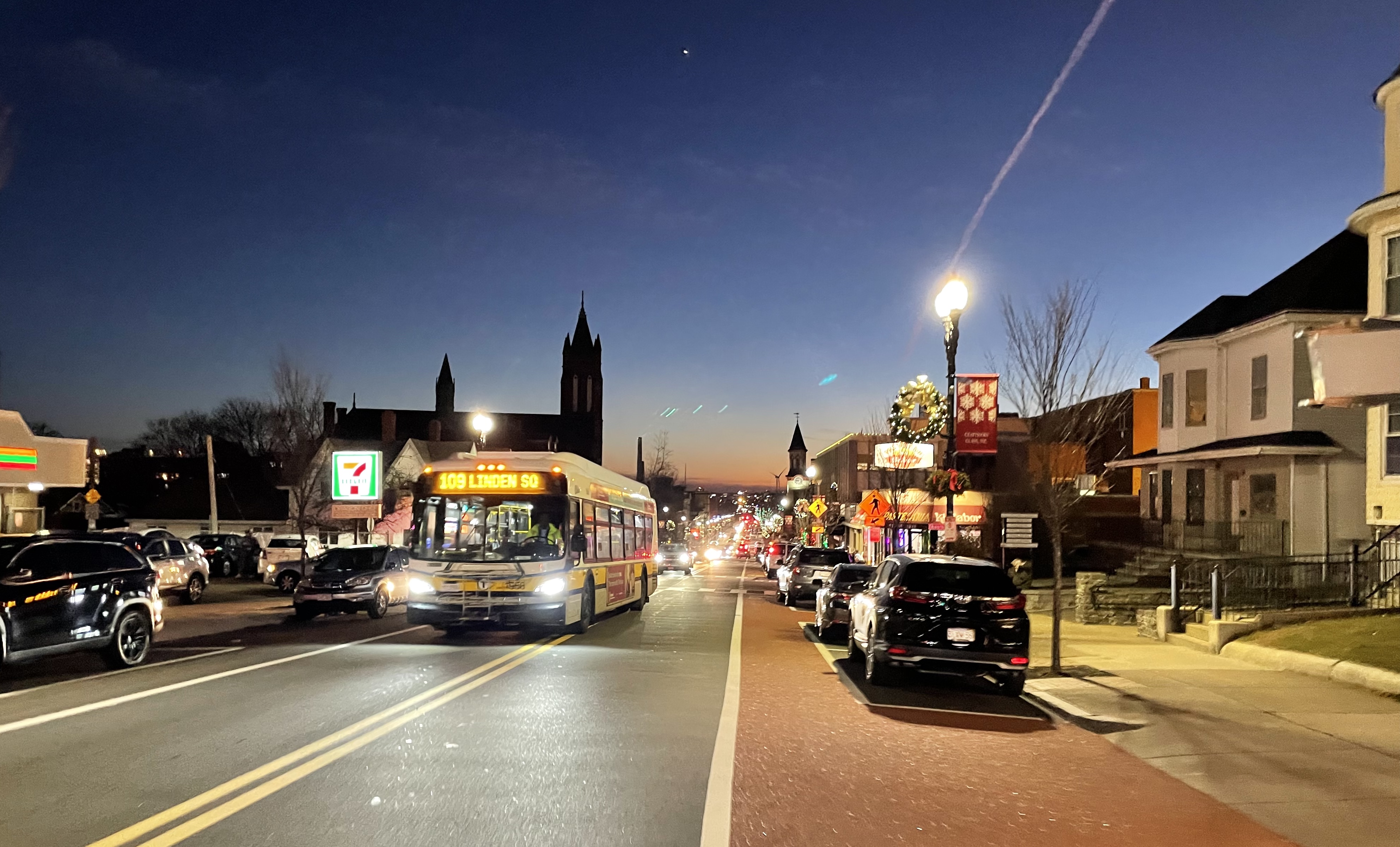
Their execution of these bus lanes has been horrendous. No enforcement. Non-existent to barely noticeable TSP. At the very least the bus lanes have been a significant improvement between Huntington and Brookline Ave, and on the outbound side in the Rt9 portion. Delay increases up in Brookline Village are probably from all the school construction. These could have done much more for transportation if they'd done anything other than slap some red asphalt down and call it done.

 
I am here nearly every single day, often multiple times per day, to transfer between 65, 66, 39, E, or D and the automobile compliance with the bus lane is absolutely abysmal. Every single light cycle during rush hour the bus lane is completely blocked by cars and even when there is a Brookline Police cruiser present in the traffic they do not do a single thing about it. In fact, Brookline Police pulls over speeders and red light runners into the bus lane in front of Brook House, funneling all traffic into a single lane, exacerbating the traffic issue. This isnt a one-off occurrence as I've witnessed it 3 times since the weather has gotten chilly and at least a couple times over the summer. This is not helped by the fact that the vast majority of traffic inbound in the morning is trying to go to Longwood, which means taking that left onto Brookline. And what are they accommodated with, only about 230ft of turning queues between poorly synced intersection timings across the three on Rt9. This pushed drivers into the bus lane because it's the only way around the backup to get into those short left-turn lanes. I've said before how the signal coordination can be changed to accommodate all traffic not just TSP for buses but an additional lane reconfiguration that would go a long way is eliminating the left-only onto Pearl and making it an extension of the Brookline turn lanes, which would also move more traffic onto the essentially wide open Walnut St to go straight across to Pearl. Doing this would turn what is currently ~370 linear feet of left-turn queue for Brookline into ~1100 linear feet (550 x 2) whilst leaving a lane much clearer as a straight shot through to Huntington and drivers not feeling as much need to encroach on the bus lane.

Roughly done in paint. Blue path shows how much additional queue length there would be for the Brookline Ave turn. Green shows the path to Pearl (where I'd also reroute the 65 inbound to avoid having to dive across all the lanes for a left turn even if a 66 transfer is less smooth). This should all fit within the existing road as long as the bus lane is shifted into the stop, idk why they designed it with space for a bus to bypass another when a bypassing bus could just stay in the normal traffic lane. This would also simplify the Walnut/Pearl signal since it'd only need a shorter left-only cycle for the left onto Walnut from Washington.
View attachment 68389
Their execution of these bus lanes has been horrendous. No enforcement. Non-existent to barely noticeable TSP. At the very least the bus lanes have been a significant improvement between Huntington and Brookline Ave, and on the outbound side in the Rt9 portion. Delay increases up in Brookline Village are probably from all the school construction. These could have done much more for transportation if they'd done anything other than slap some red asphalt down and call it done.
Route 9 EB is not wide enough for 3 lanes between High and the bus stop without serious reconstruction. This was one of the alternatives proposed when the plans were being developed but was shelved because it would require reconstruction of the entire sidewalk and bike lane area between High and Walnut.

Also, it appears within the last few days the signal coordination has been improved. It was mentioned during the last meeting that the town is working on improving the phasing. Buses appear to be moving through the corridor much faster and less gridlock is present.
 
Last edited:
Route 9 EB is not wide enough for 3 lanes between High and the bus stop without serious reconstruction. This was one of the alternatives proposed when the plans were being developed but was shelved because it would require reconstruction of the entire sidewalk and bike lane area between High and Walnut.

Also, it appears within the last few days the signal coordination has been improved. It was mentioned during the last meeting that the town is working on improving the phasing. Buses appear to be moving through the corridor much faster and less gridlock is present.
My drawing is rough but the three lanes don't start at High it starts at the bus stop, same as the existing lane configuration. I was trying to illustrate the traffic fanning out into the lanes at the bus stop not that they'd already be in 3 lanes at High. Also I realize my following street block is a little messy but it's ment to be the bus and through general traffic lane splitting off from each other, treating the previous block as a queue jump for the bus stop, and having the full bus lane be midblock through to the town line. The signal phasing has improved marginally but that doesn't change that there's not enough queue length to accommodate the traffic demand for the Brookline turn. It is still every single rush hour Rt9 green signal phase backing up the High St intersection. What they've done is made the Pearl/Walnut go green sooner to release traffic as there's a green to bring the Washington traffic from Brookline Village onto Rt9 EB, but the street blocks and left queues are so short that it leaves people blocking the EB through lane on Rt9 @ Brookline trying to merge over into the outer left turn lane. Upon further thought it'd also probably be fine to eliminate the left onto Walnut. Brookline traffic can go via Pearl and Huntington traffic has it less convenient going the same way or up to Bynner and Willow Brook and coming down, but it's realistically only a minute or two detour cause you're not mixing with the Rt9 traffic as much
 
I love this idea because it also solves another reason for the gridlock - people recognizing at the last moment that they're in the right turn only lane to High St. and cutting back into the existing queue in the left lane. I don't think enough cars are making the left onto Pearl to make a big enough difference in traffic levels on High and Walnut.
 
Just a minute ago I saw the NEBR at Readville taking delivery of 2 BEBs on flatbed trailer trucks. There were about 7 total battery buses sitting in the lot
 
Bus trips on Boston's 10 highest-ridership routes take, on average, 15 percent longer than they did when Mayor Wu took office 4 years ago, and some of the worst slowdowns have been on fare-free routes through predominantly Black neighborhoods in Roxbury and Dorchester:

 
Last night there was a public meeting to update on the Longwood Medical Area Bus Circulation Study. I haven’t seen any materials posted on the various webpages for it. Did anyone attend or have materials to share?

LMA Bus Study 11/12 meeting
Looks like the existing conditions report (which is quite thorough) is now online:
 
The biggest grant for Massachusetts will be a $78.6 million pledge to the MBTA "to buy new hybrid buses to replace older buses that have reached their useful life."
That funding will support the current MBTA capital investment plan, which anticipates about $300 million in spending for new buses over the next 5 years.
The T's planned bus purchases include up to 460 new battery electric buses and up to 160 "enhanced electric hybrid" buses that will replace 20 year-old diesel buses.
"Enhanced electric" hybrid buses have large onboard batteries that allow them to turn off the diesel engine and run on battery power for short distances.
According to the FTA's grant announcements included the following descriptions for the other funds:
  • The $4.5 million grant to the Pioneer Valley RTA will finance a renovation to its Northampton bus maintenance facility.
  • The Berkshire RTA in western Massachusetts will receive two grants: $3 million to rehabilitate its operations and maintenance facility, plus an additional $5.4 million for new hybrid buses.
  • The Lowell RTA will use its $7.2 million grant to purchase new hybrid replacements for older buses.
  • Merrimack Valley Regional Transit Authority (MeVa) will receive $7.2 million for 6 new enhanced electric hybrid buses. Noah Berger, the agency's administrator, told StreetsblogMASS on Monday that "the new vehicles will be the first 40-foot transit buses in our history and the largest capacity vehicles in our fleet, which will be ideal for meeting the demand of our burgeoning ridership." Berger added that he expects to deploy the new buses on the agency's highest-ridership intercity routes: the 24 between Lowell and Lawrence, the 1 between Lawrence and Haverhill, and the 10 between Lawrence and Methuen.
 
Thanks took me a while to get through the media. Yeah the existing conditions analysis is very thorough. I agree anecdotally from my own experience taking midday buses from Ruggles that they’re constantly busy to LMA. And the rush hour evening back to Ruggles from LMA is absolutely abysmal with no dedicated bus lane. The road widths in LMA are so constrained. I’ll be eager to see what is proposed over the next year or so.
 
Thanks took me a while to get through the media. Yeah the existing conditions analysis is very thorough. I agree anecdotally from my own experience taking midday buses from Ruggles that they’re constantly busy to LMA. And the rush hour evening back to Ruggles from LMA is absolutely abysmal with no dedicated bus lane. The road widths in LMA are so constrained. I’ll be eager to see what is proposed over the next year or so.
First time i’ve ever heard of a new D branch station at Netherlands Road… It’s on slide 10.
 
@Riverside brought up this idea last year. I think a station at Netherlands Road would get a good amount of ridership, the only downside being increased travel times on the D branch.
A great reminder that some of the actual planners and engineers on these projects (both public and private side) are either members of this forum or at least read it. If you have a good idea or solution, there's a good chance that by just posting it, you've essentially proposed it to the project team for consideration!
 
A great reminder that some of the actual planners and engineers on these projects (both public and private side) are either members of this forum or at least read it. If you have a good idea or solution, there's a good chance that by just posting it, you've essentially proposed it to the project team for consideration!
It's true but I wouldn't say it's a "good chance". There are thousands of people working at MassDOT, the MBTA, MPOs/RPAs, municipalities, consultants, etc. Please actually attend meetings, contact agencies/electeds and do the harder but much more impactful IRL work.
 
It's true but I wouldn't say it's a "good chance". There are thousands of people working at MassDOT, the MBTA, MPOs/RPAs, municipalities, consultants, etc. Please actually attend meetings, contact agencies/electeds and do the harder but much more impactful IRL work.
I'm not saying it automatically becomes "Alternative B", but during a design charette or internal options matrix, it might get included. Definitely still need to show up to community meetings to show support too!
 
An interesting oddity from the service changes effective today: the cutback of route 85 to Bow Street is now permanent. The cut occurred in July 2023 due to street construction; it was supposed to be short-lived, but was never reversed for reasons that aren't clear. (It was also planned as part of the BNRD, under which the 85 will largely be rerouted to replaced the CT2. However, the cutback was still indicated as temporary, with timetables showing the full route, until now. Ironically, the construction included bus boarding islands on Summer Street, which will now go unused.

The Spring Hill section had a long history. It originated as a horsecar line built to Putnam Street in 1883 and Central Street in 1885. It was electrified on November 21, 1893 and converted to bus on September 18, 1926. There were some modifications over the years - the Avon Street loop may have been added around 1930, part of Webster was closed in 1971, and the northern end was extended to Davis from 1975 to 1981 - but the basic bus routing persisted for almost a century.
 

Back
Top