MBTA Buses & Infrastructure

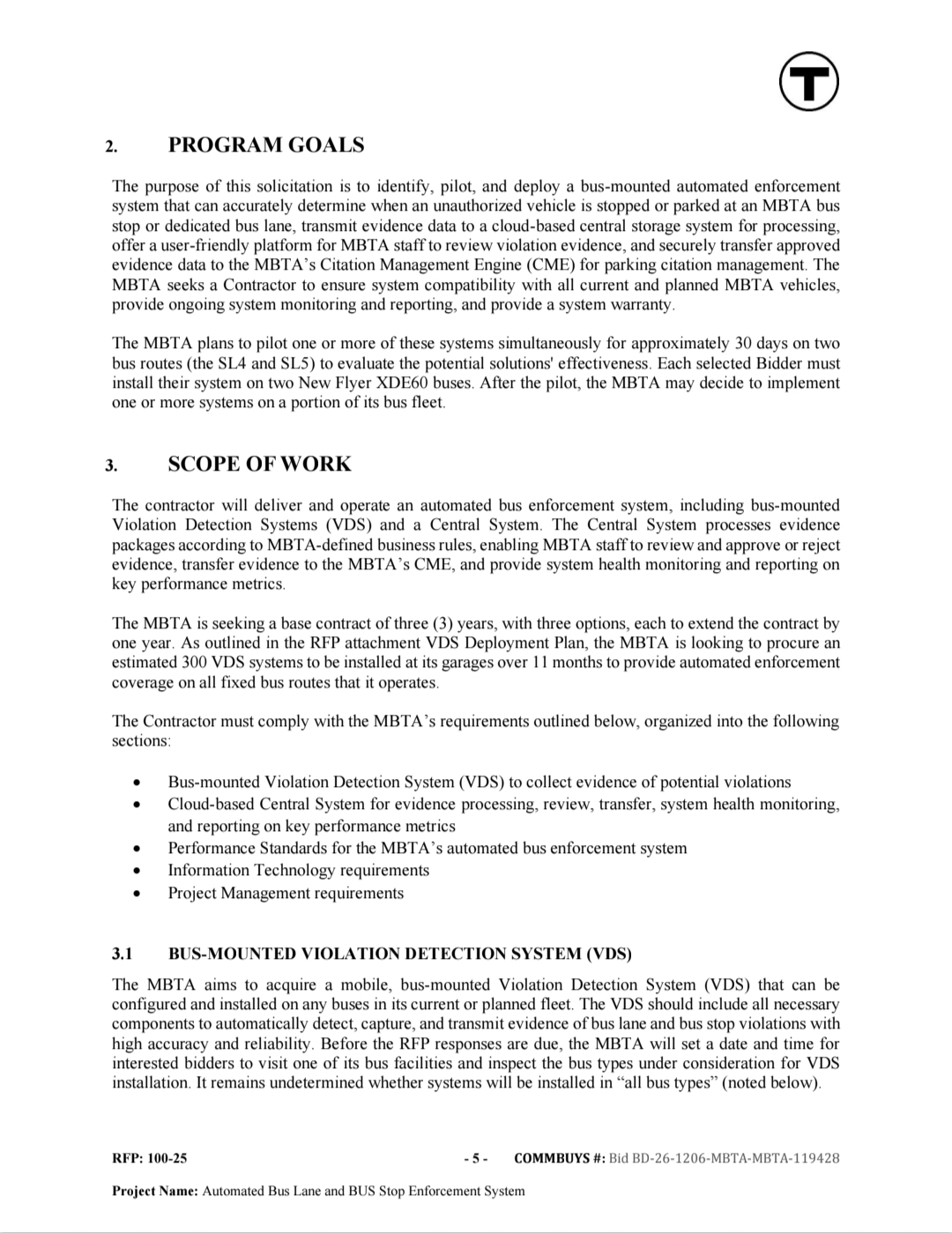
The MBTA has issued its RFP for automated bus lane enforcement - Predictably, SL4/5 are the top of the priority pile, with those buses receiving pilot installations ahead of all others. It appears the plan is currently to equip 300 out of the MBTA's 1074 buses, spread throughout the system.
1000041104.jpg

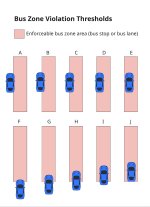
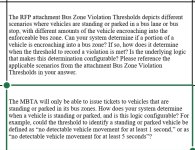
Additionally, as the T isn't allowed to automatically enforce driving in a bus lane, only standing or parking, the technical questionnaire appears to be defining standing as "no detectable vehicle movement for at least X seconds," asking prospective vendors if it is configurable and can be set by the T - examples given are as low as 1-5 seconds. Further, its seeking information on marginal examples where a vehicle is partially blocking the lane - again, the T may be fairly aggressively defining encroachment.

 

Attachments

  • Screenshot_20250815_123533_Excel.jpg
    Screenshot_20250815_123533_Excel.jpg
    251.2 KB · Views: 116
  • Screenshot_20250815_124231_Chrome.jpg
    Screenshot_20250815_124231_Chrome.jpg
    187.6 KB · Views: 112
  • Screenshot_20250815_124752_Excel.jpg
    Screenshot_20250815_124752_Excel.jpg
    192.8 KB · Views: 103
Couldn't the city control what's built on the site through zoning? If the city government wants a grocery store, and does not want the MBTA storage facility, then zone it restrictively that way.
While they could, I wonder if the MBTA could swing a bigger stick (sort of speak) to overrule local jurisdiction.
A conceptual plan that the MBTA provided to board members (pictured below) indicates that the T could replace the larger warehouse with a new bus charging facility for about 54 60-foot "bendy" buses, like the ones it uses for the Silver Line and a handful of other high-ridership routes, plus 99 more traditional 40-foot buses.
"bendy" buses is a great way to digestibly describe an articulated bus to the average joe. Love it haha
What feels like a lifetime ago, I worked in the Market Basket design offices and they always did a decent amount of site planning studies for stores (not that you'd be able to tell with the asphalt jungles lol). I wonder if it would ever be possible to have the two entities play nice and get both? A grocery store is one of the hardest entities to plan for in terms of designing space because they have a ton of leverage of where they go. So it would be a great "get" for Medford. These new charging stations also seem to be super landhogs too (Quincy is massive). So could there be a middle ground where the MBTA gets less space (say maybe half?) and Market Basket builds a smaller store (not quite as small as their Concord, NH store but not nearly as big as their Chelsea store) that would require less parking and the two live harmoniously? Is it possible that this site could be charging and maybe the Fellsway garage is demolished and rebuilt as the repair bays seeing as they are less than 1 mile apart?
 
Couldn't the city control what's built on the site through zoning? If the city government wants a grocery store, and does not want the MBTA storage facility, then zone it restrictively that way.

Maybe there's a lawyer on here who can fact-check this, but my understanding is that state agencies (including the T) are not bound by local zoning laws.
 
This can't displace Fellsway AND Lynn at the bus counts they've specced for it. Fellsway currently houses 93 40 ft. diesel buses, and Lynn 96 40 ft. diesel buses. The new site only counts out to 99 40 ft. BEB's, and 54 60 ft. BEB's...the 60-footers earmarked for upgrades to Charlestown routes with probably some tradeoffs of 40-footer Lynn/Fellsway routes to Charlestown. With BEB's, North Cambridge and new Quincy are each increasing 25% in bus quantities from their previous fleet sizes to accommodate the large required BEB spare ratios for charging downtime. So a new Medford facility +/- 40-for-60 footer route swaps with Charlestown needs to accommodate about 237 buses to replace Fellsway and Lynn. Maybe even a few more given the large deadheading miles to Medford from Lynn/Wonderland.

This isn't even close to enough bodies. As-is it's barely enough for Fellsway + 25% spares, with no way in hell they can shutter Lynn unless there's another site in the works. There has to be a follow-up move in-play, because even the "expansion" space on the 440 Riverside render isn't nearly enough to satisfy the fleet requirements for consolidating the two garages.


EDIT: The T's own Bus Facilities Modernization page still has per-facility bus counts for the previous studies' site selection.
  • Wellington: 200 buses (doesn't say what are 40-footer vs. 60-footer, but assume much like the current plan that any 60-footers would be assigned to Charlestown routes and that Charlestown would in-turn absorb an equivalent number of 40-footer ex-Fellsway routes)
  • replacement Lynn: 65 buses (with the 114, 116, 119, 120, and 121 East Boston routes all vacating Lynn for Wellington, and only Central Square/Wonderland 424, 426, 428, 429, 435, 436, 439, 441, 442, 450, 451, 455, and 456 routes remaining).
We're about 112 buses short of the agency's own BEB math...probably more, because of the Medford-Lynn deadheading distance. There has to be another large unnamed garage on-tap.
 
Last edited:
Today in minor unsolved mysteries: why is there a left turn lane on NB Starboard Way at Congress?
1755294860222.png


Starboard is MBTA-only in both directions, and buses only make right turns at this intersection. Even if non-revenue moves make the turn, I can't imagine that's worth a dedicated lane. Perhaps futureproofing for a Parcel H development (though 2022 plans only called for parking access on Port)?
 
Last edited:
Im going to quirk an eyebrow at the proposal for a Market Basket on this site - while I'm not going to deny that it'd do well and be very popular, it's also hardly a food desert as its within a stone's throw of a Wegmans, Stop & Shop and an Aldi.

IMO, it'd be better advocacy by municipal leadership to advocate for the existing Fellsway garage site. That site is so irregularly shaped that reuse would be challenging without combining with the adjacent target/Walgreens, but that would be a more valuable redevelopment opportunity. Restore the 1920 waiting room as a coffee shop, etc.
 
Last edited:
Maybe there's a lawyer on here who can fact-check this, but my understanding is that state agencies (including the T) are not bound by local zoning laws.
I have also read this in regards to the Roslindale MBTA parking lot.
 
Medford bus garage update: https://patch.com/massachusetts/medford/mbta-closes-industrial-property-medfords-riverside-avenue
[...] the MBTA closed on the former Anheuser-Busch distribution warehouse by Monday, Aug. 25.
In the aftermath of the purchase, the MBTA has reportedly compromised with Medford and will transfer ownership of seven acres of the Wellington station as well as the car house on Salem Street. Lungo-Koehn said she has asked the MBTA to hold a community meeting with the people in the neighborhood of the location.
 
Tomorrow's board slides are already mostly posted, and with them the proposed regulations for camera enforcement. Notable for its definition of standing; "Stand or Standing refers to the complete or near complete stop of an occupied
motor vehicle for any amount of time for any purpose, including breaking for traffic, traffic signals, or pedestrians, or picking up or dropping off passengers."
1000041489.jpg

1000041493.jpg
1000041491.jpg
 
Last edited:
The Brookline Select Board really wants the bus lanes on Washington Street removed ASAP. They say it can’t wait until the spring when the pilot is supposed to end which will provide alternate proposals for bus priority. They say that MassDOT repaving crew that is currently resurfacing Boylston Street between High Street and I-95 should eradicate the markings when they finish paving which should be in November. They argue that the 15 second savings for buses is not enough and say that TSP causes vehicular delay. The MBTA staff tried to explain how TSP works but the Select Board members stated that the MBTA did not understand what they were saying and asked if the MBTA will pay for the removal which was rejected, and the town says they will be making arrangements with MassDOT for removal.
 
Last edited:
The Brookline Select Board really wants the bus lanes on Washington Street removed ASAP. They say it can’t wait until the spring when the pilot is supposed to end which will provide alternate proposals for bus priority. They say that MassDOT repaving crew that is currently resurfacing Boylston Street between High Street and I-95 should eradicate the markings when they finish paving which should be in November. They argue that the 15 second savings for buses is not enough and say that TSP causes vehicular delay. The MBTA staff tried to explain how TSP works but the Select Board members stated that the MBTA did not understand what they were saying and asked if the MBTA will pay for the removal which was rejected, and the town says they will be making arrangements with MassDOT for removal.
So, I've taken a look over the original documents for this pilot.

Slide 19 says they were hoping for a 150-291 second improvement to transit trip times on the corridor.

https://www.brooklinema.gov/Documen...esentation-Bus-Prioirty-Lanes-Pilot_EEC_FINAL

------

If I am reading slides 52-57 correctly in the 10/14/25 pilot update, it seems like it's obviously failing at achieving anything, with most bus trips through the study area being slower than before implementation.

Even if we limit it to only covering the bus lane segments themselves and not the whole study area, the best trip improvement is Route 66 PM Peak inbound at 35 sec improvement.

This is the 10/14/25 pilot update: https://www.brooklinema.gov/DocumentCenter/View/59777/Select-Board-Gateway-East-Quater-4-Report

-----

It's entirely possible I've misread this. But if I haven't, I think it's pretty fair that Brookline is unhappy with it and wants it gone, as the benefits to transit at present appear to be somewhere between non-existent and <20% of what was promised.
 
  • Like
Reactions: FK4
If transit travel times aren't down from highly congested conditions, then I would guess the transit lanes were being constantly violated by autos.
 
@millerm277 Here are my thoughts based on what's in the slides alone.

First of all, there's a need to distinguish Bus Lanes vs. Transit Signal Priority (TSP) in these data. TSP was only activated in June 2025, so at most two months of TSP data got into "Project Q4" that you see on the slides. This means the "Q4" data is a 50-50 mix between "Yes TSP" and "No TSP".

The Town of Brookline's Select Board is currently threatening to eliminate both improvements -- even though the bus lanes themselves have been in use for a year.

With that said, let's actually look at the slides you cited (#52-57). Using slide #52 as the most illustrative example:

1760634217566.png


These are westbound travel times. Key points:
  • The "32 seconds slower" figure is impacted heavily by the "66 North" (D) section, which saw no changes to the street configuration at all. Its impacts do not necessarily speak of the bus lane's effectiveness.
  • The (C)section's data ("14 seconds slower") is confounded due to a combination of two different sections:
    • Station St - Kent St, where there are no bus lanes and the buses have to merge back into one-lane traffic.
    • Pearl St - Station St, where bus lanes exist. However, its effects cannot be isolated with available data.
  • The Washington St (B) section shows concrete improvements, even though they're small.
On the other hand, on Slide #57:

1760634497387.png

For eastbound travel times shown above, bus lanes do seem effective. Notably, the "turn" segment, now (B) on this slide, saves 21 seconds during PM peak. At other times of the day, this section either has similar travel times or slight time savings.

So:
  • Left-turning bus lanes are more effective than right-turning bus lanes
  • Merging back into traffic correlates with slower trips
  • Slower trips on "66 North", where no changes have been made, makes the summary statistics look worse than they actually are
None of these are surprising. To me, this points to issues both with mixed "bus + right-turning cars" lanes, and merges at the end of bus lanes. And we don't even know if TSP is already addressing some of them, given that only half of the "Q4 data" had TSP.

Another very important consideration: The "Q4" data spans different months from the baseline. The best match is actually Q1:

1760635251042.png


(You can find all quarterly reports here.)

Looking at the Q1 data, which controls for months of the year, paints a very different picture:

1760635437460.png


1760635461675.png
 

Back
Top