The Solution to America’s Housing Crisis Might Be Built in a Factory
It’s called “modular” construction, and it could allow homes to be constructed within a week.
Reframe Systems
“On a quiet street 2 miles north of Boston Common, a triple-decker is being born. These three-family clapboard sugar cubes, thrown up by the tens of thousands around the turn of the 20th century across all New England’s cities, are the backbone of Greater Boston’s working-class housing stock. Quickly built by amateur developers working off a handful of construction drawings, the wood-framed triplexes do the same thing for their neighborhoods today that they did then: provide a decent and affordable stepping stone between the city’s dim, shared quarters and a big house in the ’burbs.
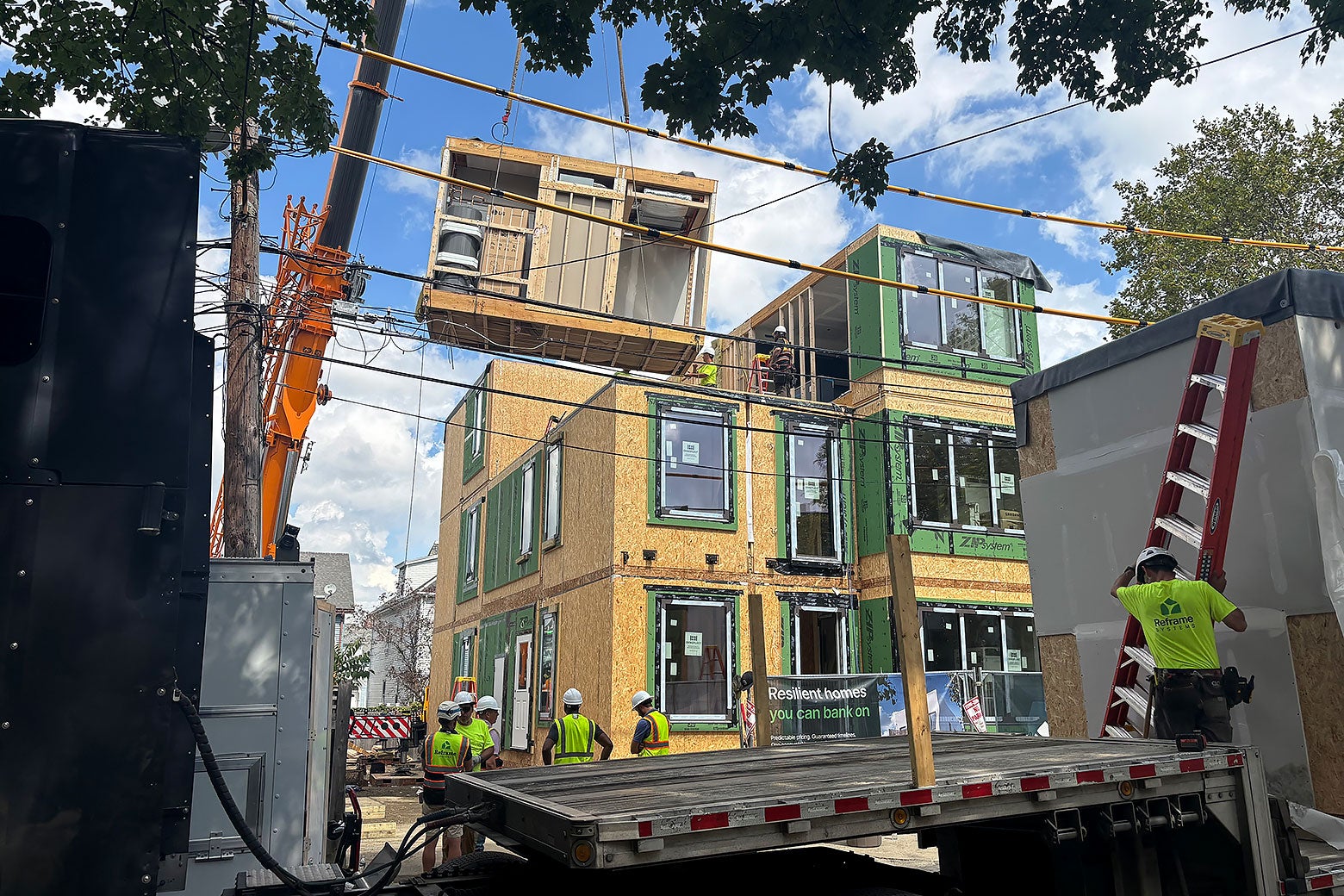
Even in that heyday of urban construction, however, no triple-decker rose as quickly as the one at 13 Gilman Street in Somerville. After the concrete foundation had been poured, its three stories were erected in four days, assembled from a kit of 24 boxes that arrived, toilets and all, on the bed of a truck. The company that makes them, Reframe, is the latest outfit chasing the construction sector’s forever dream, in which buildings are assembled in factories like computers or cars, saving time and money in a field that everyone agrees requires too much of both.
The technical name for this practice is
modular construction, which has at times seemed as if it is the undisputed technology of the future. But this time, says Reframe’s founder Vikas Enti, is different. Traditional construction costs are through the roof, fabrication technology is better than ever, and housing prices are a national crisis. The planets are aligned for modular construction. Today, Enti explains, it takes about 150 minutes of human labor to build each square foot of a small multifamily building. He claims that his company can do it in 64. One day, Reframe wants to build at a rate of six minutes per square foot.
Think of it: a triple-decker, from a pile of lumber, pipes, wires, and windows on a factory floor to a finished home in a neighborhood, in one week. This would be an extraordinary development in a city where such projects usually take a year to be completed.
In April, I visited Reframe’s factory at an industrial park in Andover, Massachusetts. Inside, Enti and I watched a robot arm hover over a pile of wooden boards using magnets and a nail gun to assemble them into a wall. It struck me as a complex way to complete a repetitive task, but that is part of Reframe’s pitch: This is not an assembly line churning out a thousand identical widgets.
Enti believes that this conveyor-belt legacy has been holding modular construction back. “The fundamental way in which factory-built homes have worked as an industry is, you build these massive 100,000-to-500,000-square-foot factories that are trying to build one type of product,” he belted over the drone of saws and drills. “We were an extension of the industry building mobile homes, trailer homes. Eventually, that became modular homes, and they brought the same practices, which work well when you’re building a few types of products again and again.”………”
It’s called modular construction, and it could allow apartments to be constructed within a week.

slate.com